

Long before we divided the year into months or named its seasons, we could watch time moving across the horizon. Sunrise shifted north and south; days lengthened and shortened; the Sun reached two apparent extremes and crossed two points of relative balance. These four turning points—the solstices and equinoxes—emerge from Earth’s axial tilt and orbit around the Sun, creating the changing distribution of light from which our seasons arise.
Human cultures across the world have observed these thresholds through calendars, agriculture, architecture, ritual, and traditions including the seasonal Sabbats associated with the Quarter Days of the Wheel of the Year. Astrology preserves the same solar architecture within the tropical zodiac: Aries begins at the March equinox, Cancer at the June solstice, Libra at the September equinox, and Capricorn at the December solstice. Yet, the experience of each turning also entirely depends upon where we stand; at the simplest level, one hemisphere enters summer as the other enters winter, revealing how this shared celestial cycle is expressed through different earthly conditions.
Meditation Practice
Take your practice to the next level, & the next… With a Year and a Day commitment.

Let’s explore how within the Cycles in Harmony cosmology, this progression becomes the energetic phases: Nourish, Activate, Fulfillment, and Integration; four phases of continuous movement, rather than separate states. Even still, we’ll see how this dependable solar year participates in greater astronomical rhythms, as Earth’s orientation and orbit change across spans of time far beyond a human life. Together, we’ll discover why each year returns us to solstices and equinoxes, but never to an entirely unchanged cosmos.

Four Turning Points
The seasons begin with a tilt. Earth’s rotational axis sits at an angle of about 23.4° relative to its orbit around the Sun, so as the planet completes each annual revolution, the hemisphere receiving the more direct sunlight changes. When the Northern Hemisphere tilts toward the Sun, it experiences longer days and greater solar intensity while the Southern Hemisphere experiences shorter days and less direct light; six months later, their positions reverse. The seasons are therefore produced by the changing angle and duration of sunlight reaching Earths surface.

The solstices mark the two extremes of this relationship. At the June solstice, the Sun reaches its northernmost declination, producing the Northern Hemisphere’s longest day and the Southern Hemisphere’s shortest. At the December solstice, it reaches its southernmost declination and the relationship reverses. Between them, the March and September equinoxes occur as the Sun crosses the celestial equator, shifting which hemisphere receives the greater share of daylight. Day and night approach balance around these crossings, though atmospheric refraction and the way sunrise and sunset are measured mean they are not precisely twelve hours each everywhere on Earth.
Seen globally, these four points reveal something more useful than a fixed seasonal calendar. The June solstice is simultaneously a threshold of summer and winter; the March equinox opens spring and autumn at once. What changes is not the astronomical event, but the conditions through which it is experienced. Cycles in Harmony follows this same dynamic distinction with the phases: Nourish, Activate, Fulfillment, and Integration; describing positions within a cycle rather than dates on a calendar. The solar year gives us a planetary demonstration of that principle, continually expressing the same underlying movement through different places, seasons, and forms.

Solstices: The Sun Stands Still
At either end of the Sun’s apparent annual journey, its movement north or south along the horizon slows until it seems to stop and reverse. This apparent pause gives the solstice its name, from the Latin solstitium, or “Sun standing still.” The June and December solstices mark the maximum extent of the Sun’s declination north and south of the celestial equator, creating the two annual extremes of daylight through which each hemisphere alternates between summer and winter.
At the winter solstice, the longest night contains the beginning of increasing light. This is is a time to Nourish. Not necessarily inactivity, but more conservation and sustaining of activities. Midwinter traditions including Yule have long gathered around this threshold, often emphasizing light, warmth, food, shelter, community, and continuity. The astronomical turning gives these associations their foundation. The darkest point is also the point beyond which darkness can no longer increase.
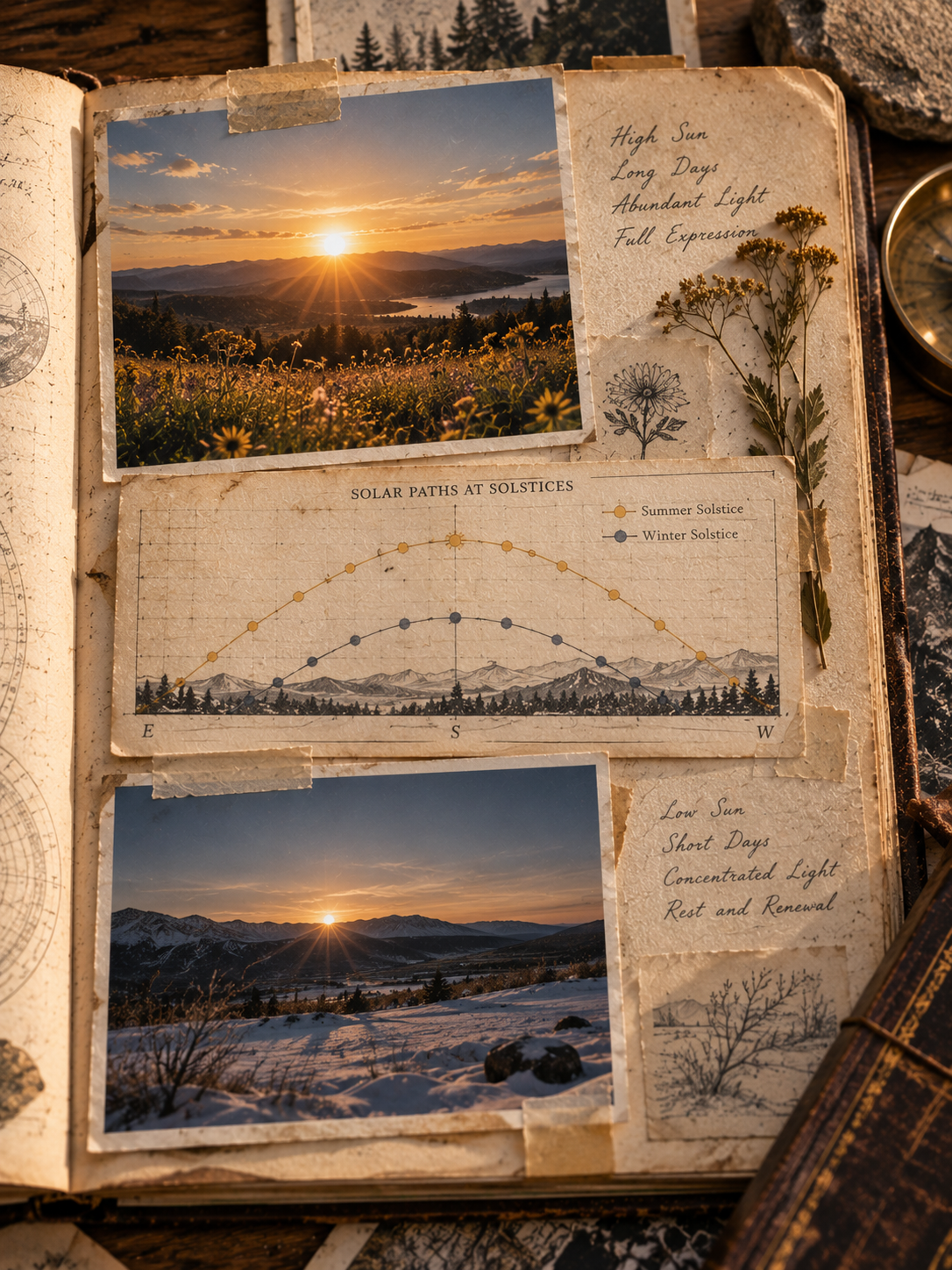
The summer solstice carries the inverse relationship. Daylight reaches its greatest duration, placing the seasonal cycle within Fulfillment, when the movement toward greater light has reached its culmination. Still, maximum light is itself is also a turning: immediately beyond the solstice, the days begin their gradual contraction. Fulfillment doesn’t suspend the cycle at its peak; it completes one movement while beginning another, allowing abundance to become ripening, harvest, and eventually Integration.
These opposing solstices occur simultaneously across the planet. June’s Fulfillment in the north is December’s Nourishment in the south, while six months later the relationship reverses. The same solar alignment can therefore signify abundance and conservation, culmination and renewal, depending upon our orientation to it. What appears to be an ending from one position is already a beginning from another.
Equinoxes: Crossing Thresholds
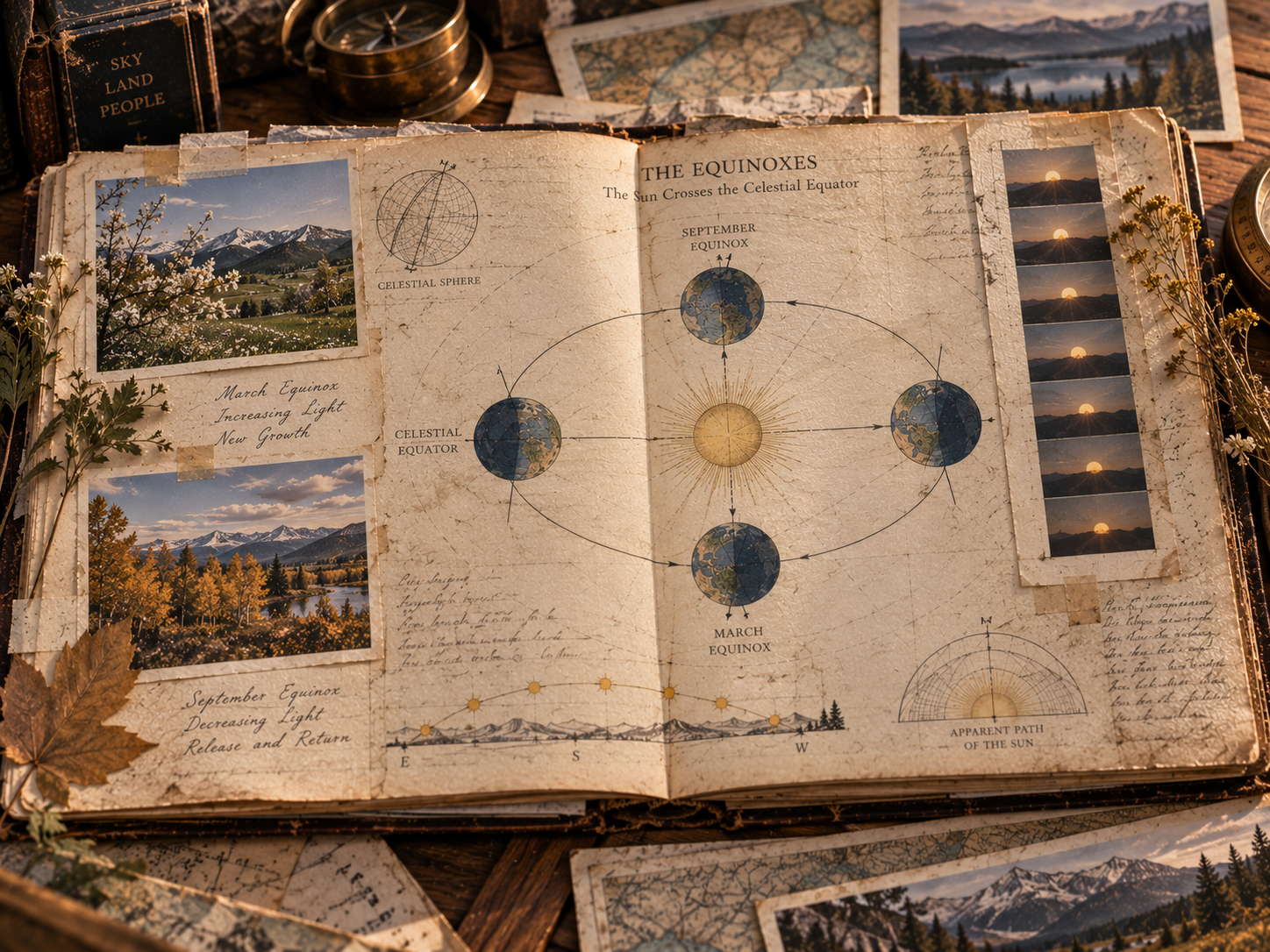
Between the extremes of the solstices, the equinoxes mark two crossings. Around the third week in March and September, the Sun crosses the celestial equator and the distribution of daylight between the hemispheres approaches balance. Unlike the solstices, where the Sun reaches an apparent limit before reversing direction, the equinoxes occur in motion: one hemisphere is moving toward greater light while the other is moving toward greater darkness.
At the spring equinox, that crossing belongs to Activate energy. Light has been increasing since the winter solstice, but now it passes the seasonal midpoint and begins to exceed darkness. The traditions associated with spring—including the Sabbat of Ostara in the modern Wheel of the Year—reflect this visible emergence through themes of germination, fertility, movement, and renewal. Activation does not create life from nothing; it describes the phase in which what has been nourished begins to move outward, becoming increasingly available for participation, development, and expression.

At the autumn equinox, the same threshold is crossed in the opposite direction. Daylight has been decreasing since the summer solstice and now gives way to longer nights, placing the cycle within Integration. Harvest traditions, including those now associated with Mabon, recognize the practical consequence of this movement: what has grown must be gathered, evaluated, distributed, preserved, or returned. Integration is therefore more than decline. It is the process through which the results of Fulfillment are incorporated into the conditions that will sustain another cycle.
Astrology preserves these opposing crossings within the structure of the tropical zodiac. The March equinox defines 0° Aries, while the September equinox defines 0° Libra; ninety degrees from each, the solstices establish 0° Cancer and 0° Capricorn. The four cardinal signs are therefore anchored to the four astronomical turnings of the solar year. Their cardinality describes exactly what these moments accomplish: each initiates a new seasonal phase, even as it continues the movement already underway.

One Sun, Many Seasons
The solstices and equinoxes belong to no single culture. Wherever people watched the sky closely, changes in sunlight offered practical information about migration, planting, harvest, weather, and the passage of time. These observations became embedded in calendars and architecture, ceremony and mythology, producing traditions as varied as the landscapes from which the same Sun was observed.
Some of these relationships remain visible in monuments and celebrations today. Stonehenge frames the solstitial Sun along its principal axis; Andean traditions recognize the June winter solstice through Inti Raymi; the Persian festival of Nowruz coincides with the March equinox; and Mesoamerican architecture preserves sophisticated relationships between solar observation, seasonal time, and ceremonial life. The Sabbats associated with the modern Wheel of the Year belong within this much broader human history of noticing celestial thresholds and giving them cultural meaning.

These traditions do not suggest that humanity once shared a single seasonal cosmology. They reveal something more fundamental: people repeatedly learned to orient themselves by observing relationships between sky and land. Even the familiar four-season model is not universal; tropical, polar, monsoonal, and other climates organize seasonal change differently. The astronomical turnings are planetary, but seasons are lived locally.
This distinction allows the Quarter Days to retain both their particular history and their wider relevance. Solstice and equinox give us shared points of celestial orientation without requiring identical interpretations of them. The same Sun can mark planting in one place, harvest in another, abundance somewhere else, and the beginning of scarcity elsewhere still. What humanity shares is not one universal experience of the solar year, but the enduring practice of looking outward, recognizing change, and locating ourselves within it.

Zodiac: Solar-Seasonal Coordinates
The four solar turnings also provide the foundation of the tropical zodiac. Rather than anchoring its twelve signs to the background constellations, tropical astrology begins at the March equinox and divides the Sun’s apparent annual path into twelve equal sections. The equinoxes establish 0° Aries and 0° Libra, while the solstices establish 0° Cancer and 0° Capricorn. Astrology therefore preserves the solar year not only symbolically, but structurally.

Each of these four points begins a cardinal sign and a new seasonal quarter. Aries corresponds with Activate, as the northern solar cycle crosses into increasing light; Cancer with Fulfillment, beginning at maximum daylight; Libra with Integration, as the balance crosses toward increasing darkness; and Capricorn with Nourish, beginning at minimum daylight. In the Southern Hemisphere, the lived seasons reverse, but the astronomical coordinates of the tropical zodiac remain the same (another useful distinction between astrology’s celestial framework and the local conditions through which we experience it).
Seen through this wider lens, the zodiac becomes more than a collection of twelve archetypes. It is also a way of locating the Sun within an unfolding cycle: beginning, sustaining, adapting, and beginning again. Cycles in Harmony follows the same underlying movement at a broader scale. Nourish, Activate, Fulfillment, and Integration describe not four destinations, but four orientations within a continuously changing whole.

Even Heaven Doesn’t Repeat, Exactly
From one year to the next, the solstices and equinoxes appear remarkably dependable. Yet Earth does not move within an unchanging celestial framework. Its rotational axis slowly precesses, tracing a circle through the sky over roughly 26,000 years. As that orientation changes, so does the position of the equinoxes relative to the background stars. The March equinox remains 0° Aries within the tropical zodiac because the zodiac is measured from that seasonal crossing, even as the constellations behind it gradually shift.
Precession is itself only one movement within larger cycles. Earth’s axial tilt varies over tens of thousands of years, while the shape and orientation of its orbit also change over immense spans of time. Together, these motions alter how solar energy is distributed across the planet and contribute to long-term climatic patterns. The annual cycle remains recognizable within them, but the conditions surrounding each return continue to evolve.

This changes what it means to call something cyclical. Earth reaches another March equinox, but not the same relationship to the distant stars; another winter arrives, but within a planet whose orientation and environment are continually changing. Cycles produce recurrence without exact repetition. Their continuity comes from recognizable relationships moving through changing conditions.
At the widest scale, the solar year becomes one cycle nested within others: days within seasons, seasons within years, years within precessional and orbital rhythms. Nourish becomes Activate, Activate becomes Fulfillment, Fulfillment becomes Integration, and Integration creates the conditions for Nourishment again—and again—endlessly new.

A Year Never Quite Returns
The solar year returns us again and again to four familiar turnings. Light increases, reaches its height, diminishes, and reaches its depth; Earth continues around the Sun, carrying each hemisphere through its own expression of the same relationship. Solstice becomes equinox, equinox becomes solstice, and the conditions of one season become the conditions from which another emerges.
Yet, nothing within this movement is truly static. The seasons change from year to year, cultures interpret them through different landscapes and traditions, and even Earth’s orientation within the heavens slowly shifts. Cycles endure not because they reproduce identical conditions, but because their relationships continue through change.

Moon Cycle Journey
Enhance your life with lunar wisdom, attuning to the rhythms of nature.
These rhythms work together, allowing us to nourish what requires time beneath the surface, activate what is ready to emerge, inhabit fulfillment without asking any conditions to remain, and integrate what each season leaves behind. May we recognize our own lives within these greater rhythms without mistaking recurrence for repetition, and may each check point along the solar cycle remind us to meet the familiar with ancient beginner’s eyes.
Thank you for joining us here on Onescence! If you enjoyed this article, you can help support this free periodical by becoming an Onesce Insider or purchasing one of our products through Onesce Press. Given your interest in transformation and personal sovereignty, perhaps you would benefit from:
Authentic Routines
WORKBOOK FEATURES:
- Identify your long-term goals so you can develop routines that bring you closer to their fulfillment every day.
- Discover your own unique energy cycle and begin working with your personal flow, rather than against it.
- Utilize modifiers in order to remain consistent, even when “life happens.”
- Experiment with your routines using a flexible and strategic tracking system that will allow you to understand your behavior and make necessary adjustments easily.
- And so much more…
You can also get your copy on Amazon. Don’t wait, start taking daily steps towards your long-term goals!
