
A significant portion of this piece was written after a brief journey to stay with the Huni Kuin in the Amazon rainforest in May 2023; it contains actual accounts of plant medicine experiences and subsequent integration processes. All edits and updates have been made by the original author.
By mayryanna
My first experience with sacred medicines came as a bit of a shock. I had been a faithful reader of a progressive philosophies website (highexistence.com) since college, and when I heard they were having a retreat I jumped at the chance to meet the minds I had been so inspired by. It wasn’t until about two weeks after paying my deposit that I discovered we would be participating in plant medicines, including Ayahuasca.
I was absolutely terrified. Had I known, I probably would not have signed up for the retreat. However, I had been aware of Ayahuasca for a couple years and had settled on a decision to partake only if it came across my path, so the surprise immediately felt destined.

My Path to Amazonia
That first journey was in 2018 and I had only just committed to my healing the year before. What started as explorations in Paganism and the occult quickly facilitated a life changing remembrance of my own magick. It was with this novel empowerment that I managed to keep my anxiety in check and made it to the jungle of Costa Rica.
Apotheosis was a remarkable experience that combined methods of yoga, breath work, and philosophy with a San Pedro ceremony and an Ayahuasca ceremony (of the Yagé tradition). The thoughtful blending lent itself to profound healing that incorporated integrative principles right from the start.
The ceremonies were what I’ve come to find as most typical and expected in many modern plant medicine experiences. All of the participants had there own separate area within which we underwent our personal healing, and the general focus was inward as we addressed our own issues and intentions, as quietly as possible. If we did share anything, it was after ceremony during community circle workshops or in our conversations amongst ourselves.
The subsequent sacred medicine experiences I had in the years following all followed this same model. I attended two more Apotheosis retreats and two other integrative retreats, with every other Ayahuasca ceremony following the Shipibo tradition.
I maintained my conviction to engage with sacred medicines only as they seemed indicated, having a minimum of 6 months and a maximum of about two years of integration between each experience. My most recent experience prior to embarking to the Amazon rainforest was in Mexico [in spring of 2021] where I participated in two retreats back to back, partaking in 6 Ayahuasca ceremonies and 4 Bufo ceremonies during that time.

Moving Beyond Healing
Every one of my past experiences, despite having similar formats, were different and varied. Mama Aya always gave me exactly what I needed, which was never the same thing.
At the end of the first retreat in Mexico, mama Aya told me that “[I] can continue to heal as long as [I] choose too, but [I] can also choose to be healed.” I chose to be healed, not knowing what might await me on the other side of the healing I had grown accustomed to. The second retreat then proceeded to provide me with lucid Ayahuasca experiences, in which I was finally able to understand how shamans can partake of the medicine and still remain present for the participants.
After my experiences in Mexico, I wasn’t sure if I would return to sit in ceremony with Aya again. I was eager to explore what being healed meant, focusing on integration and authentic embodiment throughout the two years that followed. I had by no means decided to avoid medicine experiences, but I wasn’t sure what place medicines had in my journey anymore if I was no longer actively seeking healing either.
Alas, when the invitation to go to the Amazon came through a friend and colleague, I was delighted to find my heart was already there. With absolute certainty, I knew I would soon be in the Amazon rainforest with the Huni Kuin as soon as I saw a video of the shamans speaking about the experiential offering in front of their sacred tree, Shanua. I couldn’t understand their foreign language, but my spirit didn’t need to know what they were saying in order to feel the call.
I had no idea what to expect, given that every one of my past experiences with sacred medicines was completely different, but also because it would be my first time going without the intention of healing in some capacity. Despite my unknowing, my intuition remained strong, and I felt perhaps I would be clearing out the debris left over from my healing journey. This proved to be true, but I also had so much to learn.

New Experiences with Ancient Traditions
The Huni Kuin wasted no time in integrating our small group into their rich culture, greeting us in full ceremony dress and pulling us into a tribal dance as soon as we stepped foot into the village clearing. We were then introduced to the Shamans and elders, as well as given a synopsis of what we could expect during our time with them. They had plans to keep us busy for the entirety of our ten day stay in the village, interspersing culturally immersive activities throughout several traditional medicine ceremonies.
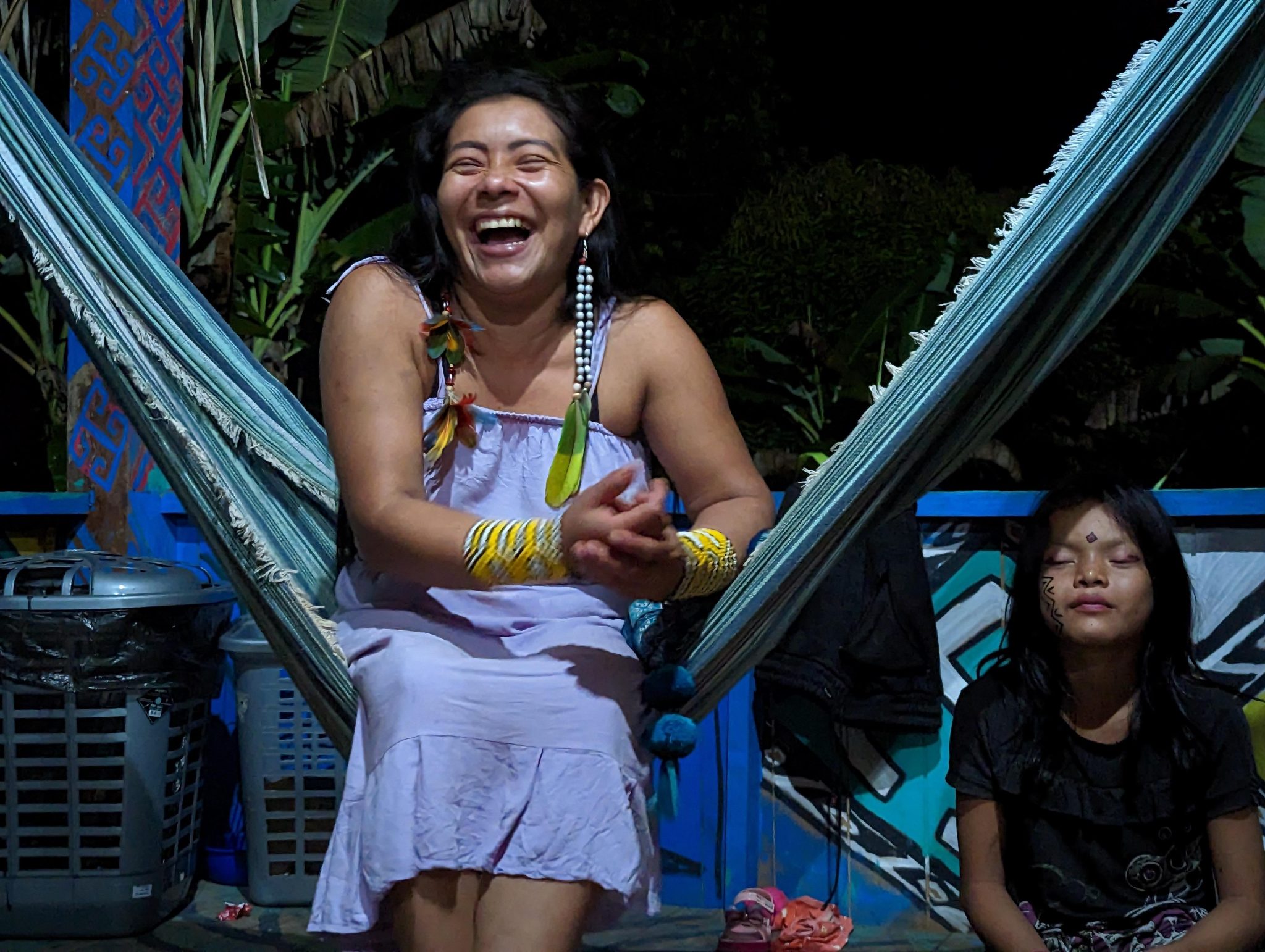
Our time there moved very fast as the tribe flowed through their rituals and routines, which allowed for very few moments of personal reflection. Our first ceremony took place on the second night, after we had been stained by villagers with the sacred patterns in the ink-like juice of the jenipapo fruit earlier that day.


Stark differences between the indigenous methodology and the Western interpretations I had encountered before became undeniable as the first ceremony unfolded. The sacred building was packed, as several Huni Kuin had traveled from other villages to participate in our opening ceremony. We were not given mats or much personal space, instead sitting around the maloca with the tribe and visitors, segregated with the men on one side and the women on the other.
The novelty continued as the txanas sang their sacred songs the whole night through. The Huni Kuin all danced without ceasing around the sacred fire as well. The medicine was gentle with me that first night, allowing me to purge easily with both cups, and I did my best to participate in the celebratory energy of the tribe through to sunrise.

Navigating Cultural Challenges
The Huni Kuin traditions were very different from everything I had experienced before, but they felt magickal. I had no resistance to the tribe’s traditions, having come with an open heart and mind that was eager to experience their culture, but it quickly became apparent that not everyone in my group shared these sentiments at breakfast the next day.
In the Aya traditions that have been brought to the Western world, it’s most common to find stillness with the medicine, lying alone on your personal mat as you work through whatever comes up on your own. Many of us had (knowingly and unknowingly) been expecting this, and when we were instead kept actively engaged with the tribal community throughout the night, it left some of us unsatisfied and confused.
Some of the group voiced their concerns that this style of working with the medicine didn’t allow for the deep healing they were expecting. They felt that the incessant singing and dancing had brought them out of their internal processes, and for that reason some were even frustrated by the expectations of the tribe. They weren’t ready to engage with the community in their traditional ways, instead suggesting that we should ask them to make adjustments for us.
Personally, I was shocked by this resistance. We had journeyed for days just to reach the remote locale and I was delighted with the indigenous traditions in all their purity. It seemed odd to expect special treatment from the tribe, or that our Western interpretations of the ancient medicines they’d used throughout their history was somehow better or “right.” I wanted to have an authentic experience, but still, I kept my mouth shut and found myself simply avoiding these conversations as best I could.
Adjustments Made with Grace
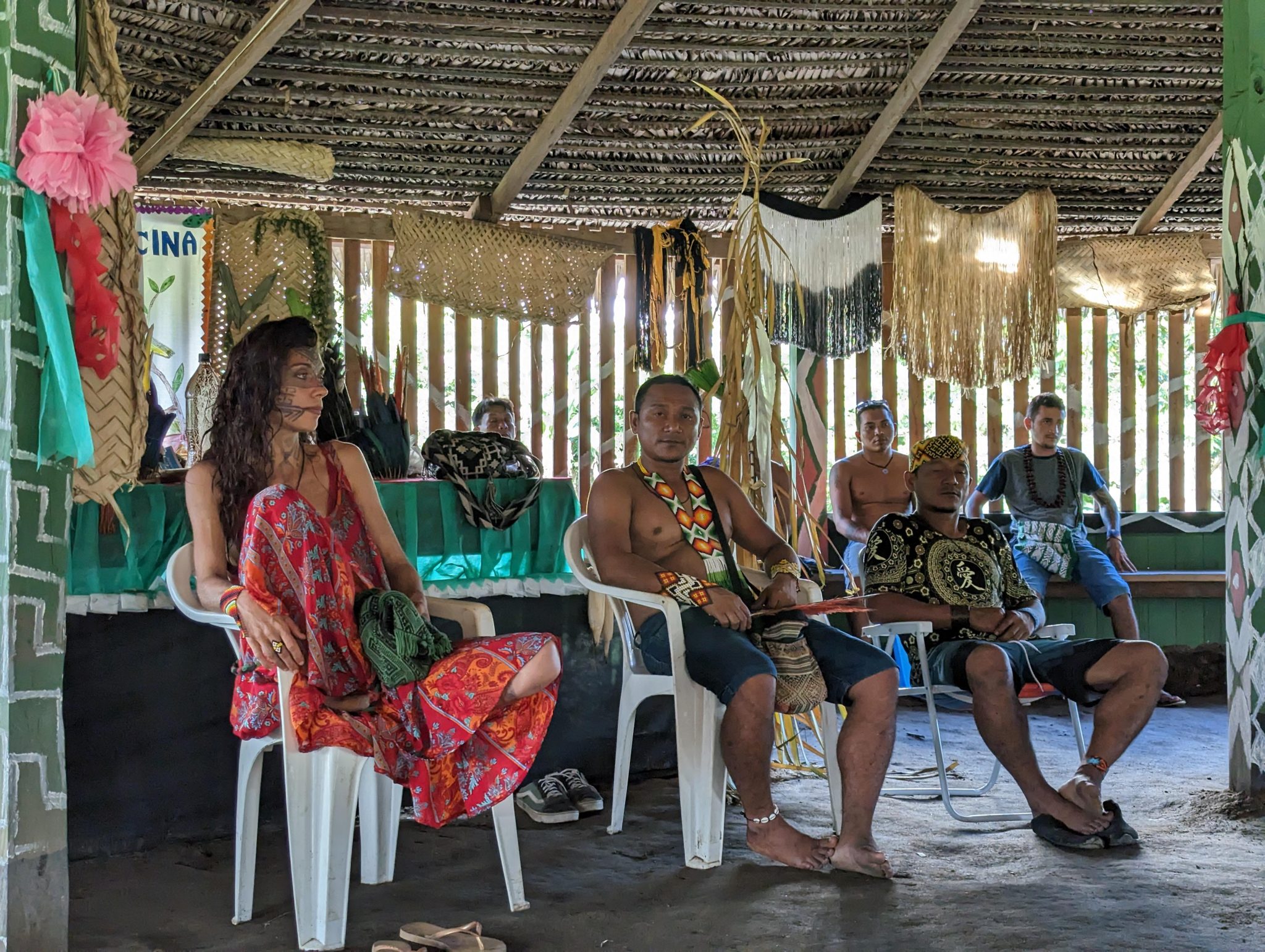
Word travels fast in a village, and before our next overnight ceremony we were called into the maloca to have a conversation with the shamans about the expectations and requests of the group. They were eager to understand and open to all suggestions, but also did their best to explain their traditions as well. They shared that they sing and dance all night to keep the energy high, and I began to better understand that they worked with the medicine as a community rather than as individuals.
Given their lives in the village, this communal focus made perfect sense. The children were all reared together, the food prepared together, the crops tended together, the hunting done together. Yes, there was some stark segregation of tasks between the women and men, but within those groups everything was accomplished as a collective.
It couldn’t be more different than our Western, individualistic customs. Still, both groups managed to communicate openly and with respect, and the Shamans took our experiences into account. Their sincere hope was to be better prepared to host more Westerners in the future, so that they could continue to share their traditions.

Disappointment and Curiosity
I couldn’t help but feel a bit disappointed in my group. I found myself gravitating towards the tribe and leaning on our translator to help me have more and more conversations with our hosts. I learned that their people had been made slaves by the Portuguese and were banned from speaking their own language for generations. They had been denied their basic human rights and not allowed to practice their sacred traditions, instead building wealth for their oppressors. Working on rubber plantations, they unwillingly stripped their rainforest home of resources and sent uncontacted tribes fleeing deeper and deeper into the jungle to avoid capture and coercion.
It broke my heart to hear of the injustices these incredibly generous and gracious people had suffered. Yet, I couldn’t help but find myself in awe of their resilience and faith as they opened up their home to us, sharing their culture so freely with people who surely looked like those who had wronged them. I was also disgusted by the irony that we had essentially asked them to once again give up their traditions for the sake of our white privilege.

Needing More than I Wanted
Fortunately, though they made some allowances for us, the Huni Kuin didn’t abandon their customs either. In the remaining three overnight ceremonies we participated in, we were provided with woven-palm mats and allowed to keep to ourselves for more individual processing, but the txanas still sang as the villagers danced all through the night until sunrise.
I found myself struggling more in these ceremonies as well, and despite my desire to participate fully with the tribal community and their traditions, I spent plenty of time on my mat in my own individual processes. This was especially the case during the last two ceremonies, as I had developed some “jungle-guts” and had to adjust to my weakening physical state. Yet, throughout it all, the Shamans and villagers remained kind and attentive.
I was especially blessed by the diligent work of the tribe’s elder medicine woman, Pajé Maspã. I had found out through my conversations amongst the tribe that she was in her seventies, and though her weather-worn face had hinted at her advanced age, it was a marvel to witness her overall vitality. In ceremonies, she was wholly devoted to smudging the entire gathering, person by person, again and again and again… This practice was only interrupted when she would intuitively work with an individual to help with their process. Then inevitably, typically several hours into the ceremony, she would retire to dance in ceaseless abandon around the fire. This seemed to indicate her satisfaction that the energy was completely clear, as her demeanor would shift from serious and focused to joyful and unbothered.

As my own process continued to deepen throughout the journey, Maspã was there for me during all of my most difficult struggles. Whether collapsing outside of the maloca during a ceremony as I tried to make my way to the outhouses, when I almost fainted during a traditional dance, or while I was violently purging on a non-ceremony day, she would somehow always show up right when I needed her. She worked patiently and attentively with me, speaking calmly to me even when the translator wasn’t around. Somehow, at different times she managed to inform me that she needed to put hands on my stomach, that I needed to follow her for a traditional herbal bath, or that she was going to apply sananga to my eyes, all without my full comprehension of her words.
One of my most cherished memories will forever be when this little woman took my hand in hers and guided me through the village for an herbal bath on a particularly hard day. I had been ill and could hardly stand, and at over 6 feet tall I towered over her 4 foot 5 frame. Yet, without any hesitation or fear, she led me barefoot along the jungle paths and in her strength I managed to find my own.

Realizing My Own Biases
Towards the end of our stay with the tribe, I did manage to speak up to my group about my feelings. I challenged them to consider the opportunity we had been given as something more than any expectations we might have had, and I told them that I was grateful for the chance to experience the traditions of these people in all their purity. I even ventured to ask them to consider protecting the Huni Kuin culture as a unique and special gift, rather than try to turn it into just another Westernized plant medicine experience.
At the time, I felt defensive on behalf of the tribe that had so graciously invited us into their lives and it felt so important to bring attention to the value of such a strange and wonderful experience. Certainly, I have no regrets in doing so. However, as time has passed, I have begun to realize how much I needed the adjustments that were made on behalf of us foreigners as well. As much as I wanted an entirely authentic experience, I couldn’t handle it. As a Westerner, with the challenges and struggles of my own culture so deeply engrained within me, I required more individual care and wasn’t capable of fully participating in the community element in all the ways that came so naturally to my new indigenous friends.

Learning to Accept and Give Grace
Despite my desires for the ancient to some how prove more valuable than the modern and for the indigenous customs to remain more sacred than the Western allowances, what I have found is that both and neither are true. This is perhaps the greatest lesson I learned from the Huni Kuin: all perspectives are valid. Gracefully, they maintained their passionate reclamation of their culture, language, and traditions, even as they remained open to carefully consider the foreign customs and needs of our group. They didn’t make us wrong the way I had tried to, they simply made adjustments and continued on.
Surely, as my integration process continues, I will realize more and more of the incredible potential this shift in my awareness offers. My hope in sharing all of this now is to invite others into this space of “both and neither.”
The Huni Kuin may not have all the answers, but Western culture doesn’t either. Still, when we embrace opportunities to learn from perspectives that differ from our own, we open up new possibilities for growth, compassion, and understanding. It is within this expansive grace that any of us can break through the limitations of our own culture to discover more about our shared humanity, and that is worth whatever challenges it may present.