

Duration: 19 minutes
In a world full of distractions, staying present has become one of the most radical things we can do. Between endless notifications, responsibilities, and worries about the future, it’s easy to lose touch with the only place life truly happens: right here, right now.
That’s where mindfulness comes in—not as a lofty ideal, but as a practical, everyday tool for clarity, resilience, and connection. When we cultivate mindfulness and present-moment awareness, we begin to access a deeper sense of peace—not by changing our circumstances, but by changing how we meet them.

Meditation Practice
Take your practice to the next level, & the next… With a Year and a Day commitment.
Whether we’re new to mindfulness or returning to it with fresh intention, understanding its foundational principles gives us a flexible framework we can grow with. In this article, we’ll explore six principles that can help us bring more awareness, compassion, and presence into our daily lives—no matter how full or fast they may be. Let’s begin where all true transformation happens: in the now.
#1: Mindfulness is a Practice and a Way of Being
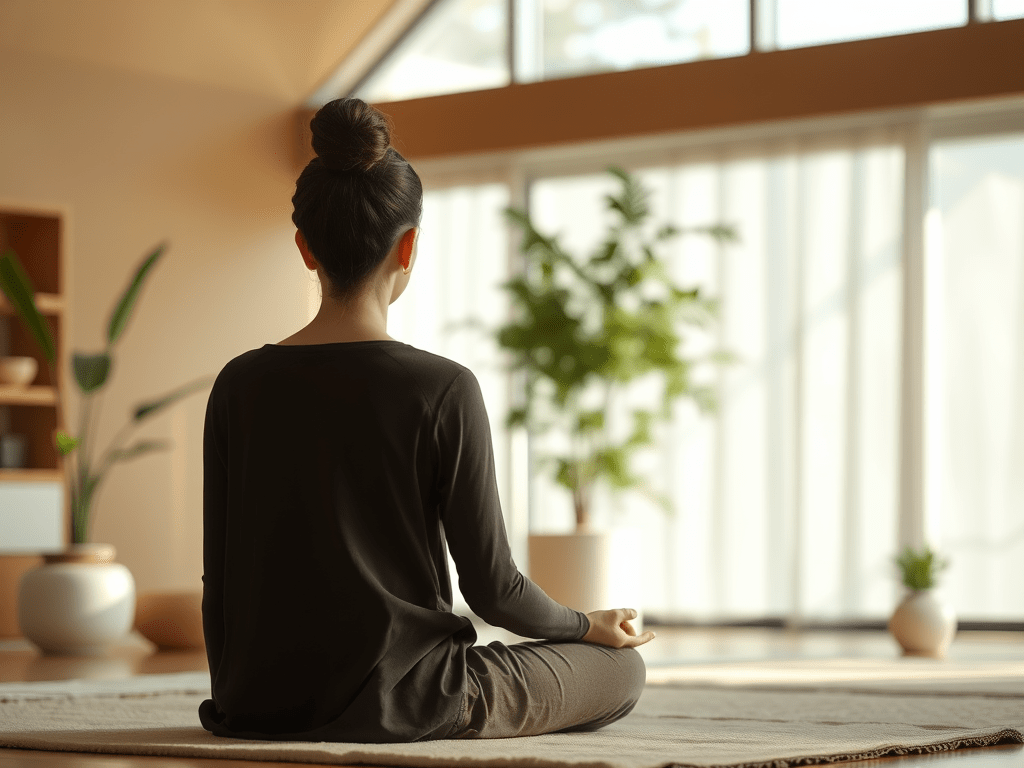
At its heart, mindfulness is the art of paying attention—on purpose, in the present moment, and without judgment. It sounds simple, but in practice, it asks us to slow down, soften our inner dialogue, and become fully aware of what’s happening right now. That awareness becomes the foundation for emotional clarity, self-compassion, and intentional living.
There are two dimensions to mindfulness: one is a practice, the other is a state of being. The practice is something we do—like breathwork, meditation, or mindful walking. These activities train our attention and strengthen our ability to stay present. The state of being, however, is something we become—an embodied way of moving through life with awareness and grace.

Much of what we know about the psychological and physiological benefits of mindfulness comes from research in programs like Mindfulness-Based Stress Reduction (MBSR), developed by Dr. Jon Kabat-Zinn at the University of Massachusetts. Studies show that MBSR can reduce anxiety, improve immune function, and even alter brain structures involved in attention and emotion regulation.
The beauty of mindfulness is that it’s always available to us. We don’t need perfect silence or hours of free time. A single, intentional breath—taken in awareness—is a mindfulness practice. Over time, those small moments become a way of being, helping us stay grounded and open even amid change, challenge, or uncertainty.
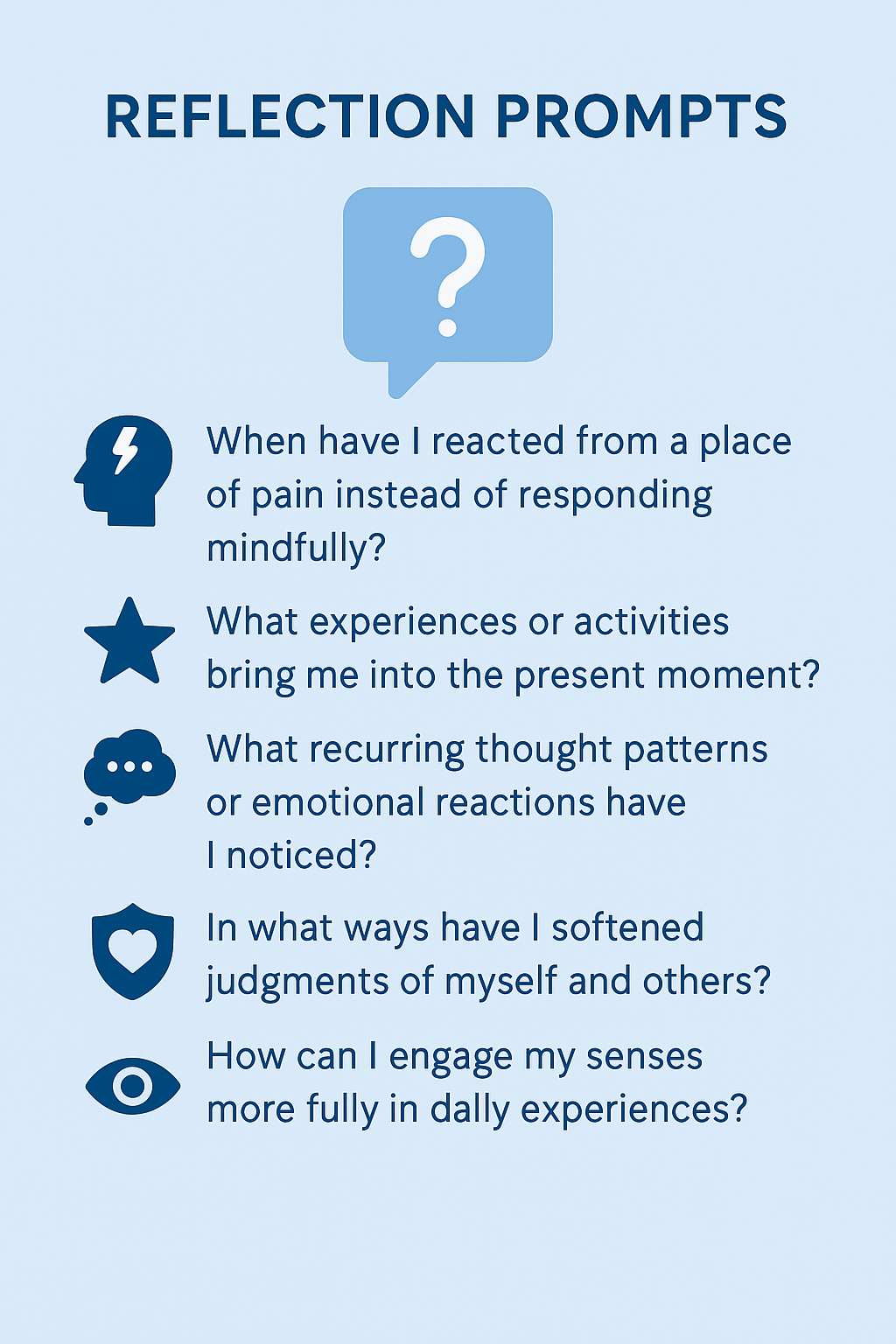
Mindfulness Reflection Prompts
- When in my day am I most present? When do I tend to disconnect from the moment?
- What does it feel like when I’m fully present in my body, in my space, in my life?
- What thoughts or feelings tend to pull me out of the present moment? What happens when I just observe them instead of believing them?
- What am I currently judging or resisting within myself? How might I meet it with curiosity instead of criticism?
- Which of my senses most easily brings me back to the present? How can I engage that sense more intentionally today?
- Which part of my day could become more meaningful with just a little more presence?
Reflection prompts are powerful tools for deepening mindfulness by creating space for intentional self-inquiry. Rather than letting thoughts and emotions pass unnoticed, prompts help us pause, notice, and engage with curiosity. They shift us from automatic reactions to conscious awareness, revealing patterns and encouraging meaningful presence.
Used regularly, these prompts ground us in the present moment, enhance emotional clarity, and strengthen our connection to ourselves. By focusing on areas like sensory awareness or internal dialogue, we transform everyday experiences into opportunities for insight and alignment.

#2: Embracing the Present Moment with Awareness
The present moment is the only place where life actually unfolds. It’s where joy is felt, decisions are made, healing begins, and transformation takes root. Yet for many of us, the present can feel elusive—overshadowed by regrets about the past or anxiety about the future.
Embracing the present moment isn’t about ignoring what has happened or pretending the future doesn’t matter. It’s about shifting our focus to the space where we hold the most influence: now. From this grounded awareness, we become more empowered to act with purpose, rather than react out of habit.

Neuroscience supports this shift. When we practice presence, activity in the default mode network (DNM)—the brain’s storytelling and mind-wandering center—decreases. This allows us to experience life with more clarity, rather than through a fog of assumptions or autopilot behaviors.
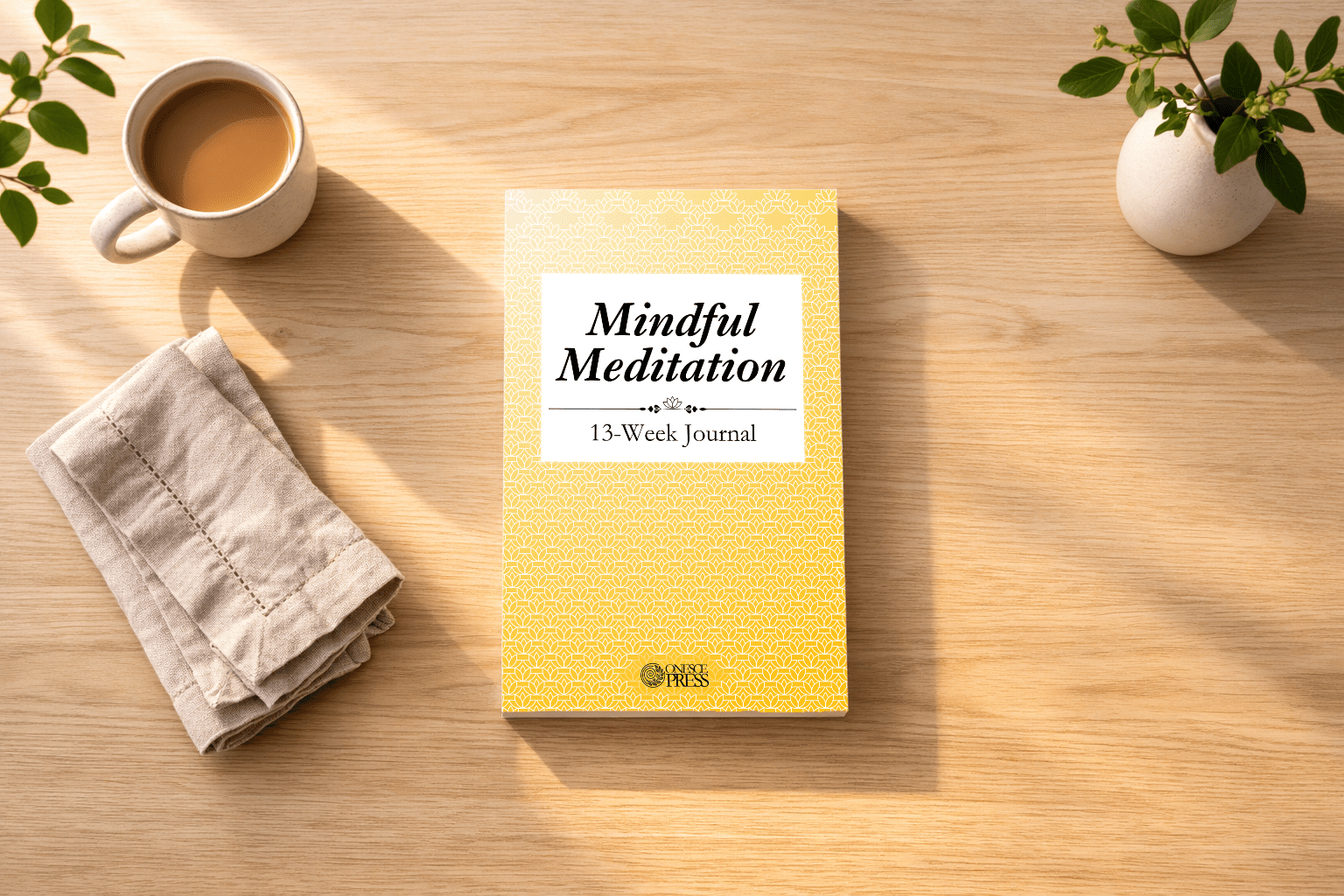
Mindful Meditation
Quiet your “monkey mind,” record your experiences, & deepen your practice.
Spiritually, being present reconnects us with a sense of timelessness. Teachings from mindfulness lineages, Taoism, and teachers like Eckhart Tolle all point to the now as sacred ground—the portal through which peace, presence, and power return.
A Mindfulness Micro-Practice:
Right now, pause and notice:
- 5 things you can see.
- 4 things you can touch.
- 3 things you can hear.
- 2 things you can smell.
- 1 thing you can taste.
The grounding technique above quickly reorients our attention to the moment—no special tools required. It really can be that easy to practice mindfulness and begin to exercise our awareness.
When we begin to live in the moment, we also start to create more intentionally. We curate our energy with purpose and attention, letting go of outdated narratives or future-focused stress. This is where true manifestation begins: not by projecting forward, but by fully embodying the energy we wish to live in now.

#3: Gracefully Observing Thoughts and Emotions
Thoughts and emotions are natural currents of our inner landscape. They rise and fall, shift and swirl, often without our conscious invitation. In mindfulness practice, we learn to observe these mental and emotional patterns without becoming entangled in them. This shift—from identification to observation—is one of the most empowering aspects of mindful awareness.
Instead of labeling thoughts as “good” or “bad,” we begin to see them for what they are: passing experiences, not permanent truths. This detachment doesn’t mean we suppress or avoid emotions. On the contrary—it means we create enough space to witness them clearly, respond with intention, and choose how we want to engage.

Psychologically, this mirrors the principle of cognitive defusion found in Acceptance and Commitment Therapy (ACT). Rather than fusing with every thought or feeling, we practice stepping back and watching them arise like clouds in the sky—acknowledging their presence without letting them define us.
One effective way to strengthen this skill is through automatic writing or mindful journaling. By simply letting thoughts and emotions spill onto the page without editing or judgment, we give them form and space. Over time, this reflective practice builds clarity, insight, and emotional fluency.
The Mindful-Pause Technique
When triggered or overwhelmed, pause for just a moment:
- Take a slow breath in and out.
- Name what’s present: “I’m noticing frustration.”
- Choose your response intentionally.
The simple practice above creates a buffer between stimulus and reaction, allowing our values—not our patterns—to lead the way. By taking a simple pause, allowing ourselves to ground and center, we allow ourselves the chance to respond from a place of presence and purpose rather than reactivity or trigger.
Furthermore, as we deepen this awareness, we begin to notice the stories we tell ourselves: beliefs inherited from the past, assumptions rooted in fear, habits formed in survival, etc. This recognition gives us the chance to make our subconscious motivations conscious—and to realize, we don’t have to live from those states anymore.

#4: Cultivating Non-Judgmental Awareness
Mindfulness invites us to witness our experience—not through the lens of right or wrong, but through the eyes of curiosity and compassion. This is the heart of non-judgmental awareness: learning to be present with what is, without needing to fix, label, or resist it.
So often, our inner narrative is shaped by judgment. We criticize our emotions, compare our progress, or second-guess our instincts. But when we meet our thoughts and feelings with acceptance rather than analysis, something shifts. We soften. We breathe more freely. We begin to trust ourselves.

In Buddhist psychology, this approach is called equanimity—the balanced, steady presence that allows us to hold both joy and discomfort without clinging to either. In modern psychology, it’s echoed in self-compassion research, which shows that treating ourselves with kindness leads to greater emotional resilience, motivation, and well-being.
Meditation Practice
Take your practice to the next level, & the next… With a Year and a Day commitment.
This kind of awareness also helps us peel back layers of conditioning. Cultural norms, family expectations, and societal pressures often teach us to suppress, override, or judge parts of ourselves. Mindfulness gives us the freedom to question those patterns—not with rebellion, but with openness. We begin to choose authenticity over approval.
Practicing Non-Judgement
When a difficult thought or feeling arises, pause:
- Instead of labeling the experience as “bad,” name it neutrally: “I’m noticing tension,” “There’s a feeling of fear,” or “This is a heavy thought.”
- Breathe, allowing the experience to be there without pushing it away or resisting.
Over time, practices like the one above help us to build self-confidence and assurance—enabling us to trust in our ability to be with ourselves, no matter what arises. It also allows us to extend this same grace to others more easily as well, making us more compassionate and understanding.

#5: Engaging the Senses to Deepen Our Presence
Our senses are doorways into the present moment. Every sound we hear, texture we feel, scent we notice, or flavor we savor can instantly reconnect us to now. In mindfulness practice, engaging the senses grounds us—not just mentally, but physically and energetically—into our environment and experience.
When we’re caught in thought spirals or emotional overwhelm, the senses can anchor us gently back into the body. This is why sensory mindfulness is used in practices ranging from trauma healing to meditation and yoga. It creates direct access to presence without needing to think our way into stillness.

Even the simplest sensory acts can become profound:
- Feeling the texture of warm water while washing our hands.
- Noticing the light shift through a window.
- Tasting food slowly and intentionally.
- Listening deeply to a song or the sounds of nature.
These are more than just moments of relaxation—they are opportunities to awaken. Each sense becomes a tool for reconnection, an ally in remembering how to fully inhabit our lives.
This is also where we can reclaim pleasure as a spiritual practice. Savoring a comforting cup of tea, appreciating the colors in a meal, or enjoying the warmth of a cozy blanket isn’t indulgent—it’s a way of honoring life as it unfolds.
Engaging the Senses
Some practices to explore include:
- Mindful eating: Focus on the taste, texture, and aroma of your food without distractions while enjoying a meal.
- Walking meditation: Feel the soles of your feet connecting with the earth as you move slowly and intentionally, notice the breeze or sun on your skin, listen to the sounds around you…
- Sound bathing: Listen with your full attention to ambient sounds or music, allowing them to wash through you without any judgment of what they stir within you.
By engaging our senses in these ways and others, we return to the richness and fullness of life. We don’t have to escape to feel peace—we can find it right here, through what we can touch, see, smell, hear, and taste.

#6: Practicing Mindfulness in Everyday Activities
Mindfulness doesn’t have to be limited to meditation cushions or silent retreats. In fact, its most transformative power often shows up in the ordinary—in the way we brush our teeth, fold laundry, prepare meals, or speak to others. Every action becomes an opportunity to be fully present, to infuse intention into the seemingly mundane.
This is where mindfulness becomes a lifestyle. By bringing awareness into our everyday tasks, we transform routine into ritual and distraction into devotion. We create a life that feels more lived-in, more meaningful, more alive.

One effective way to do this is through habit-stacking—pairing mindfulness with something we already do regularly. For example:
- After brushing your teeth, take one mindful breath before reaching for your next task.
- While making tea or coffee, tune into the aroma, the warmth, or the sound of water.
- During transitions (like walking to your car or between meetings), use those few minutes to check in with your body and breath.
Mindful Meditation
Quiet your “monkey mind,” record your experiences, & deepen your practice.
We can also apply mindfulness to emotionally charged or tedious moments. Washing dishes can become a gratitude practice. Waiting in line can become a breath awareness exercise. Difficult conversations can become a space for compassionate listening.
Practices like yoga, gardening, or mindful walking already invite this awareness—but the real magic happens when we extend it to areas we usually rush through. That’s where lasting transformation takes root. Remember: You don’t need to do more—you simply need to bring more of yourself to what you’re already doing.
Daily Mindfulness Template
Choose one daily activity (e.g., eating lunch):
- Set an intention before you begin.
- Eliminate distractions (put away phone, turn off TV).
- Focus on your senses—taste, smell, temperature, texture, etc.
- Pause regularly to breathe and reflect: “I am here. I am present. I am fully aware of this experience…”
- End with gratitude.

Conclusion: When it Comes to Mindfulness, Presence Is the Practice
Mindfulness isn’t about perfect stillness or always feeling calm—it’s about showing up for life as it is, moment by moment. When we cultivate awareness, observe without judgment, engage our senses, and bring presence into everyday moments, we begin to experience life with more depth, clarity, and purpose.
These six keys are more than techniques—they’re invitations. Each one offering a way to reconnect with ourselves, return to the moment, and live with greater intention. Whether we start with one breath, one pause, or one mindful walk, the journey begins exactly where we are.
Presence is not a destination—it’s a way of being. And every time we choose to return to it, we strengthen our ability to meet life with grace, resilience, and joy. So let’s keep choosing presence, one mindful moment at a time.