


Fire is one of the most natural forces we can witness, yet also one of the most transformative. It begins quietly, often as a small spark, then grows into something that reshapes everything it touches. It warms, illuminates, and consumes; turning one state into another without hesitation. We feel its effects in the rising sun after winter’s long stillness, in warmth returning to the soil, and in the subtle shift from rest into movement that marks the arrival of spring.
Across cultures, fire has been understood not only as a physical element, but as a force that transforms and connects, carrying energy from one state into another. When we begin to recognize this elemental pattern in different traditions, we start to see that movement itself is part of a larger rhythm of unfolding or transformation.
Let’s explore how fire has been understood as a living, transformative force through the lens of Agni, the Vedic god of sacred fire. We’ll begin by considering who Agni is and connect his sacred flame to Aries’ archetype, exploring how these forces of ignition shift stillness into action. We’ll also attempt to uncover what Aries and Agni reveal about the nature of beginnings, why action often comes before certainty, and how this energy moves through both the world around us and our own lived experience.

Agni—The Living Flame
In Vedic tradition, Agni is known as the god of fire, but this title only begins to describe his role. Agni is not simply a figure associated with flames, but the embodiment of fire itself as a living, active force. He is present in the hearth, in the sun, and in the spark that ignites transformation. Fire, in this context, is not separate from life—it is one of the primary ways life changes, moves, and continues.
To understand Agni, it helps to begin with what fire actually does. When we place food over a flame, it becomes something new; raw ingredients are transformed into nourishment. When a fire burns wood, it turns it into heat, light, and ash, releasing what was stored within it. Fire alters the state of whatever it touches, often quickly and without reversal. This is why it has long been seen as a force of transformation, not just destruction. It does not simply end something; it changes it into something else.
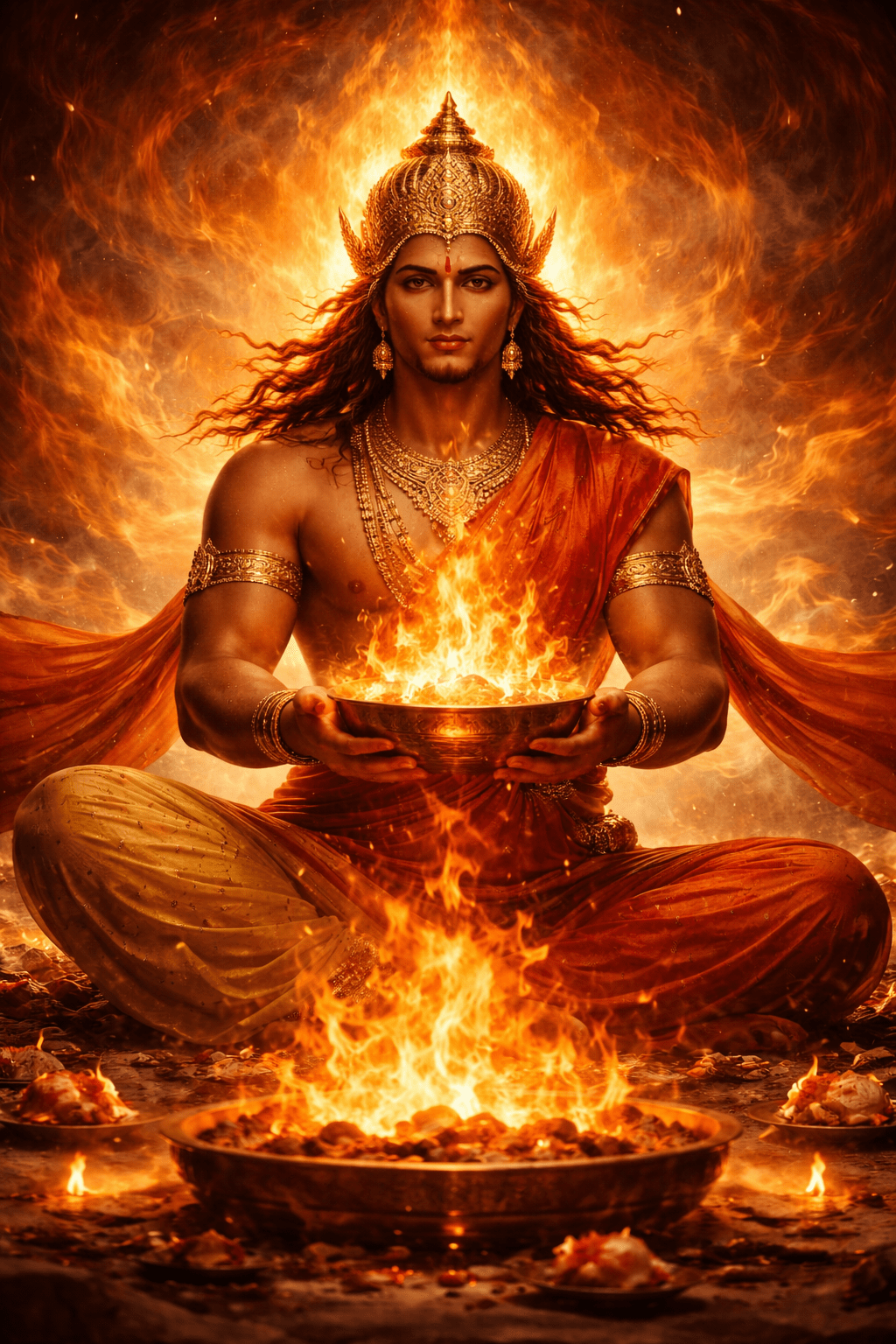
Agni also carries a deeper role as a connector. In Vedic ritual, fire is used to carry offerings, acting as a bridge between the visible and the unseen. What is placed into the fire does not disappear—it is transmitted, transformed, and carried forward. In this way, Agni represents movement between states: from physical to subtle, from intention to action, from one phase of existence into another. He is not static. He is the process through which change happens.
Seen through this lens, Agni becomes less about mythology and more about function. He represents the moment something begins to shift, when energy becomes active and transformation is set into motion. Fire does not wait for permission, and it does not remain still once it has been lit. It spreads, it grows, and it alters its surroundings. This quality—immediate, initiating, and transformative—is what makes Agni such a powerful archetype for understanding beginnings.
When we recognize fire as a living force rather than a passive element, we begin to see how its nature appears in other parts of life. The same divine principle that allows fire to transform matter also appears in moments of action, decision, and movement. This is where the connection to Aries begins to emerge, not as a symbolic comparison, but as a shared function within the cycle of change.

Aries—Energy of Ignition
Aries marks the beginning of the astrological cycle, arriving at the Spring Equinox in the Northern Hemisphere (when day and night stand in equal balance before light begins to grow). This is when the cold stillness of winter gives way to subtle movement as the ground softens, the air warms, and the first signs of life begin to emerge. What was dormant starts to stir, and what was hidden begins to rise into form.
This moment in the year is defined not by completion, but by initiation. There is a sense of activation, the solar-dominant half of the year has been set in motion and it cannot be stopped. The energy of Aries reflects this exact phase. It does not sustain or refine what already exists; it brings life into movement where there was previously stillness.
Seen through the lens of Agni, this becomes easier to understand. Just as fire begins with a spark that transforms everything it touches, Aries represents the spark within the seasonal cycle. It is the point where potential becomes active, and where intention begins to take form through movement. This is why Aries is associated with beginnings—it initiates what comes next.
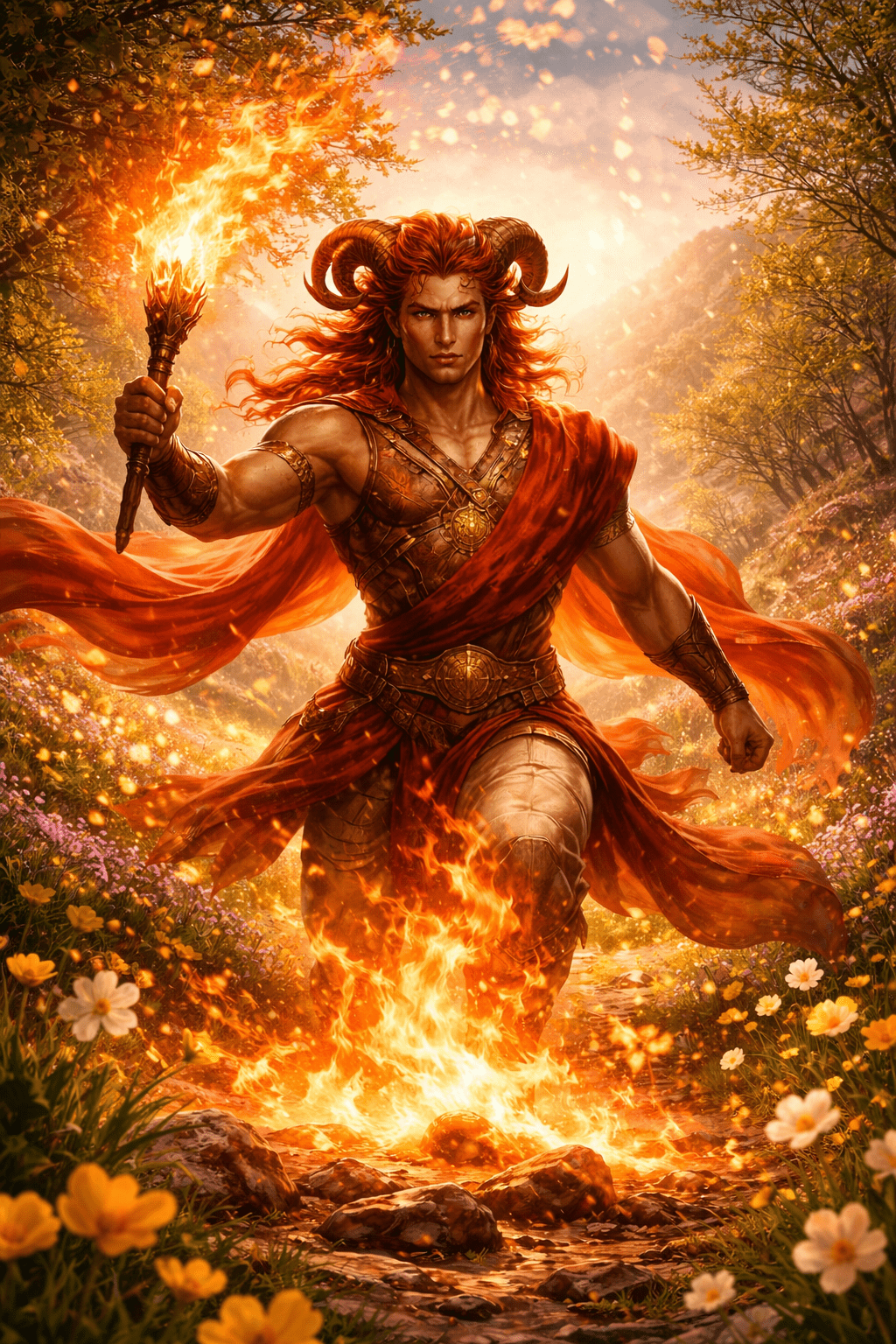
In nature, this ignition is unmistakable. Seeds break through the soil, animals emerge from hibernation, and the landscape shifts from quiet preservation to active growth. None of these processes wait for perfect conditions or complete certainty, they move because the cycle has reached a point where movement is required. Aries carries this same principle, reflecting a stage of life where action becomes necessary for its continued unfolding.
Therefore, rather than viewing Aries as a set of traits, we can understand it as the ancients did: a moment in time and a phase within a larger rhythm. It represents the transition from inward to outward, from rest to motion, and from possibility to expression. In the same way that Agni represents the living flame that initiates transformation, Aries represents the moment that flame appears within the cycle, setting everything into motion.

Fire & Action: Where Aries & Agni Converge
When we place Aries and Agni side by side, the connection becomes clear through what they do rather than what they represent. Both are tied to beginnings, not as abstract ideas, but as active forces that initiate change. Agni, as fire, transforms the moment it is lit. Aries, within the seasonal cycle, marks the moment when life begins to move again. In both cases, there is a shift from stillness into motion, and from potential into action.
Agni shows us that fire does not wait for certainty, it begins with a spark and grows through contact, spreading as long as there is fuel to sustain it. This process is immediate and irreversible. Once something is placed into the fire, it cannot return to its original state. Aries carries this same quality within the cycle of time; when this phase arrives, movement begins whether or not conditions feel fully prepared. The energy of Aries does not pause to consider—it advances—bringing the growth of spring into motion.

At the same time, there is also an important distinction in how each operates. Agni is the mechanism of transformation itself, the process that alters one state into another. Aries, on the other hand, is the timing of that process within a larger cycle. It does not create transformation on its own, but echoes when the natural transformation begins to take place. In this way, Agni explains how change happens, while Aries shows us change being activated.
This distinction helps clarify a common misunderstanding. Aries is often described as impulsive, as though its movement lacks direction or thought. Yet, when viewed through the lens of the fire element, this movement becomes necessary rather than reckless. Fire cannot exist without action, just as growth cannot occur without some form of disruption. The first step in any process is rarely perfect or fully understood, but it is required for anything to continue unfolding. Aries reflects this stage, where action comes before refinement.
Both archetypes also reveal that beginnings are not sustained states. Fire must be fed to continue burning, and the initial spark is only one part of a longer process. Aries does not carry a project to completion or stabilize what has been started. Its role is to initiate, to create the conditions for movement, and then to give way to the phases that follow. In this sense, Aries and Agni are not responsible for maintaining what they begin, only for ensuring that something begins at all.

Archetypes of Initiation
When we understand Aries and Agni together, a clear pattern begins to emerge. Both represent the moment where something shifts from potential into action, where energy that has been building begins to move outward. This is the archetype of initiation, not as an idea, but as a lived process. It represents the point in any cycle where something begins, often without full clarity, but with enough momentum to move forward.
Agni shows us that fire must be engaged with directly. It cannot be controlled from a distance, nor can it be sustained without attention. It requires fuel, space, and a willingness to work with its nature rather than against it. In the same way, Aries reflects a phase of life where energy is present and asks to be used. Ignoring it can lead to stagnation, while forcing it without direction can lead to burnout. The work is not in suppressing the flame, but in recognizing when it has appeared and responding to it with awareness.
This is where the idea of working with the sacred flame becomes practical. There are moments when something feels ready to begin, even if the outcome is uncertain. The impulse to act, to speak, or to move forward often arrives before a complete plan has formed. Rather than seeing this as a lack of preparation, it can be understood as the natural order of initiation. Fire does not wait until it fully understands what it will become, it begins. It is through the beginning that the path reveals itself.

Both Aries and Agni also remind us that initiation is only one part of a larger cycle. The first spark is powerful, but it is not meant to carry everything on its own. Fire that is not tended will either burn out or spread without direction. Therefore, working with these archetypes also involves knowing when the role of initiation is complete. Once something has begun, it must eventually move into phases of building, sustaining, and refining, each with its own rhythm and requirements.
Seen this way, archetypes of initiation are not about constant action, but responding at the right moment. It means recognizing when energy has shifted and allowing that shift to guide the next steps. Aries marks the time in the solar cycle when this movement becomes necessary, while Agni shows us how that specific type of elemental movement transforms what it touches. Together, they offer us a more grounded understanding of beginnings, not as something to force or perfect, but as opportunities to recognize and engage with what naturally arises.
The Flame That Begins All
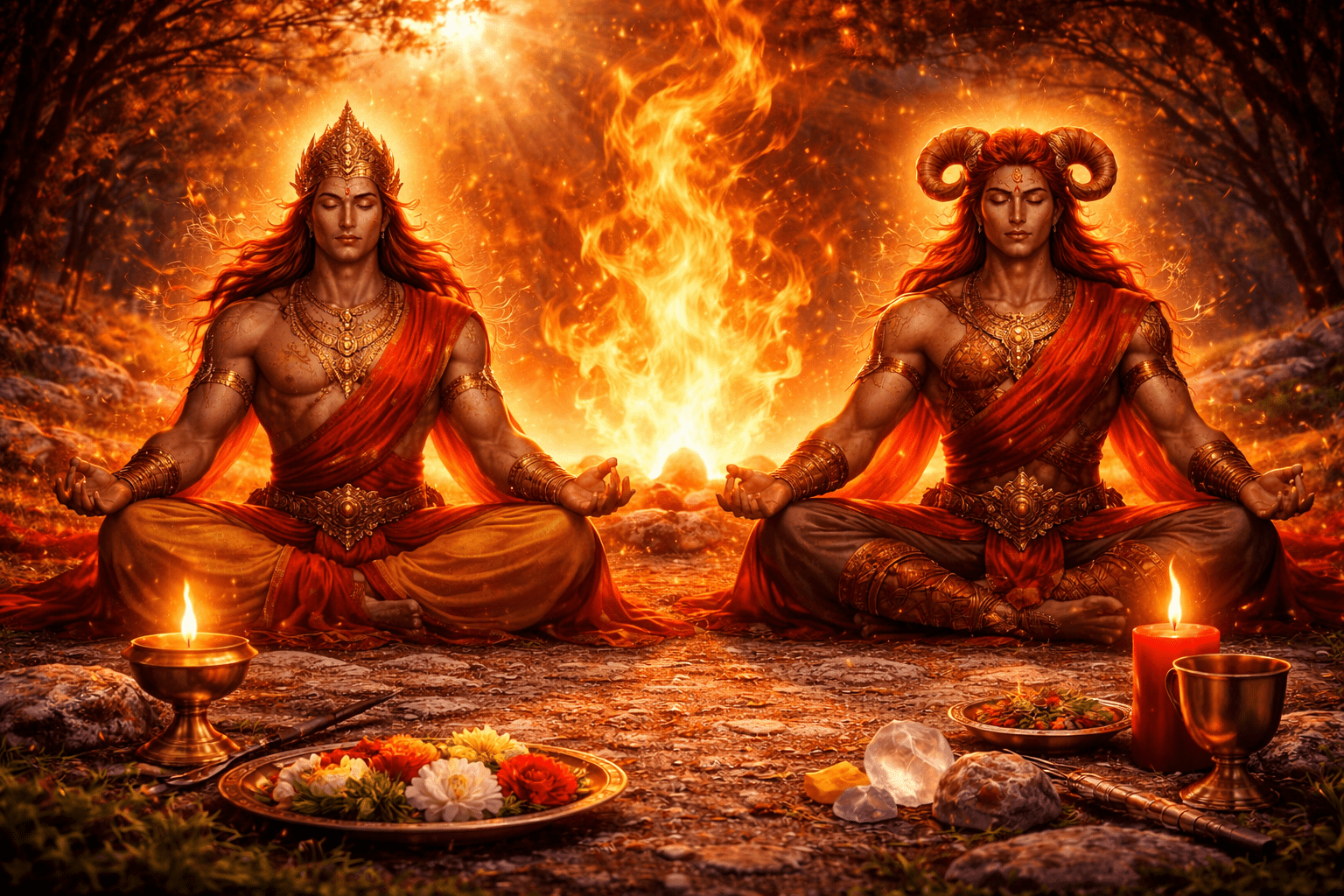
When viewed through the lens of Agni, Aries becomes something far more grounded and essential than a set of traits or tendencies, revealing itself as a function within the cycle of life. Agni shows us how fire transforms, how it changes what it touches and carries it forward into something new. Aries shows us when transformation begins, marking the point in the cycle where movement becomes necessary and growth can no longer remain dormant.
Together, they offer a clear understanding of beginnings as active, rather than passive events. Initiation is not something that waits for certainty, nor does it require a complete plan to unfold; it arises when conditions have reached a point where movement is the next natural step. Through these archetypes, we learn that the impulse to act, to begin, or to move forward is part of the larger rhythm that’s always unfolding—both in nature and within our own lives.
As the cycle turns and the energy of initiation arises, the question is not whether the spark exists, but whether we recognize it when it does. There are moments when something is ready to begin, even if the outcome remains unclear. In those moments, the work is not to hesitate or perfect, but to engage with the movement that is already present.