

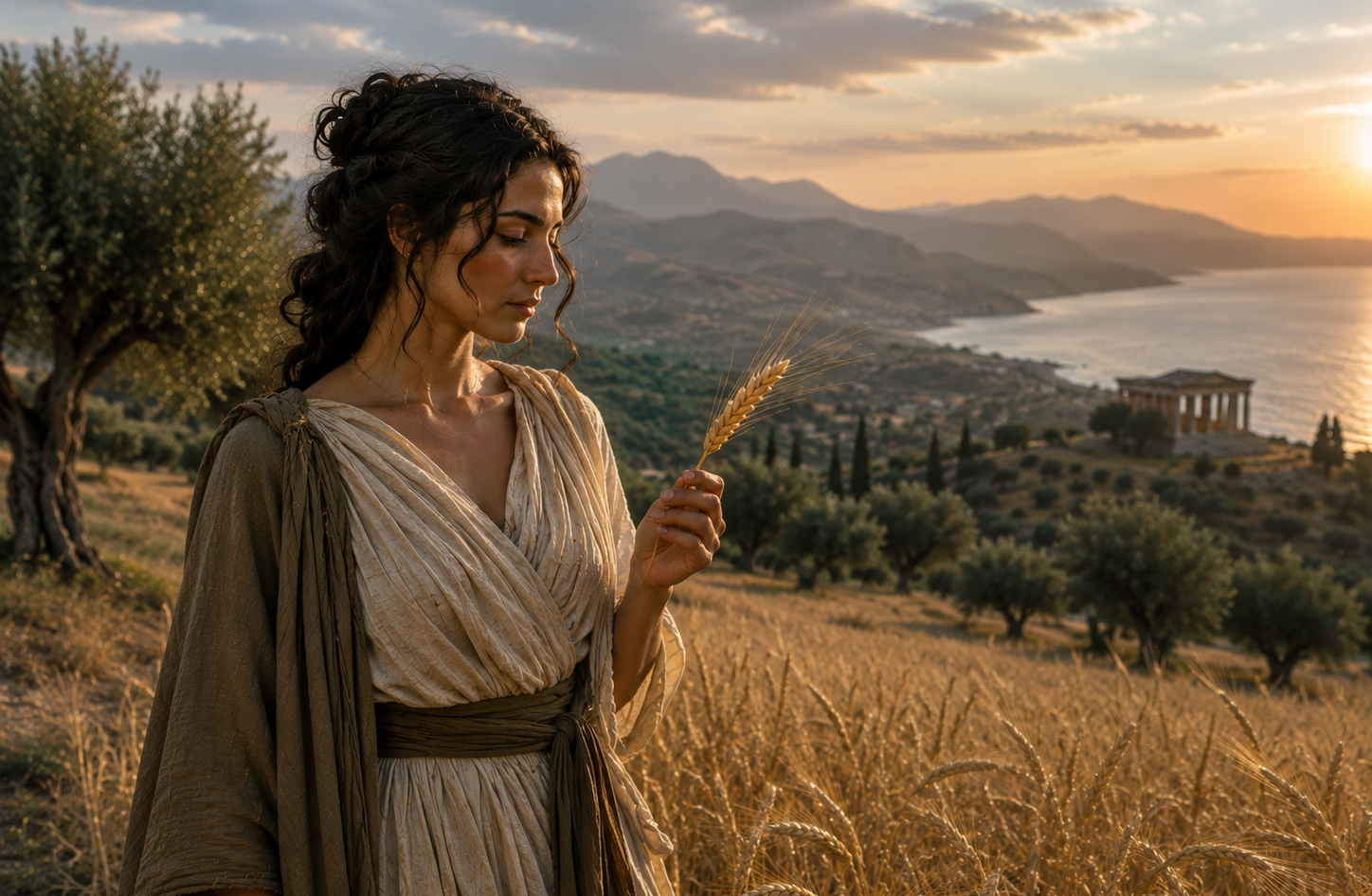
Long before Virgo became shorthand for perfectionism, organization, or an exacting attention to detail, the constellation carried a far older story: that of a Maiden who once lived among humanity, witnessed the changing conditions of the world, and eventually withdrew from it. The Greeks knew this celestial figure as Parthenos, the Maiden, and among the identities associated with her was Astraea, closely related to Dike, the personification of justice. In Hellenistic imagination, preserved most vividly by Aratus, she was not originally a remote goddess dispensing judgment from the heavens, but a presence among people, sharing the earth with them until the character of human life no longer resembled the world in which she had once belonged.
Astraea’s association with justice can easily lead us toward modern ideas of morality, law, punishment, or even the relentless standards we have come to associate with Virgo, yet her mythology invites a more elemental interpretation. The order she represents exists before any human ideal of perfection: in the relationships between actions and consequences, cultivation and harvest, or what conditions allow something to flourish and what happens when those conditions change. Through Astraea, Virgo’s familiar discernment begins to look less like an impulse to correct imperfection and more like the capacity to perceive natural order clearly enough to recognize when we are—or are not—living in relationship with it.
Sustainable Habits
Support for your journey of transformation, from planning through to integration:

Let’s explore Astraea’s origins and her relationship with Dike, her place among humanity during the mythic Golden Age, the progressive withdrawal that eventually carries the Maiden into the heavens, and the ear of grain she holds there as Virgo. As we follow her story from presence to separation and finally cultivation, we can begin to see why this ancient goddess offers such a compelling context for the Virgo archetype: one rooted in discernment, integrity, and attentive participation within the conditions that sustain life. Together, we’ll learn why these archetypal maidens suggests that natural order is something we continuously participate in through how we choose to cultivate.
Astraea: Justice Before Judgment
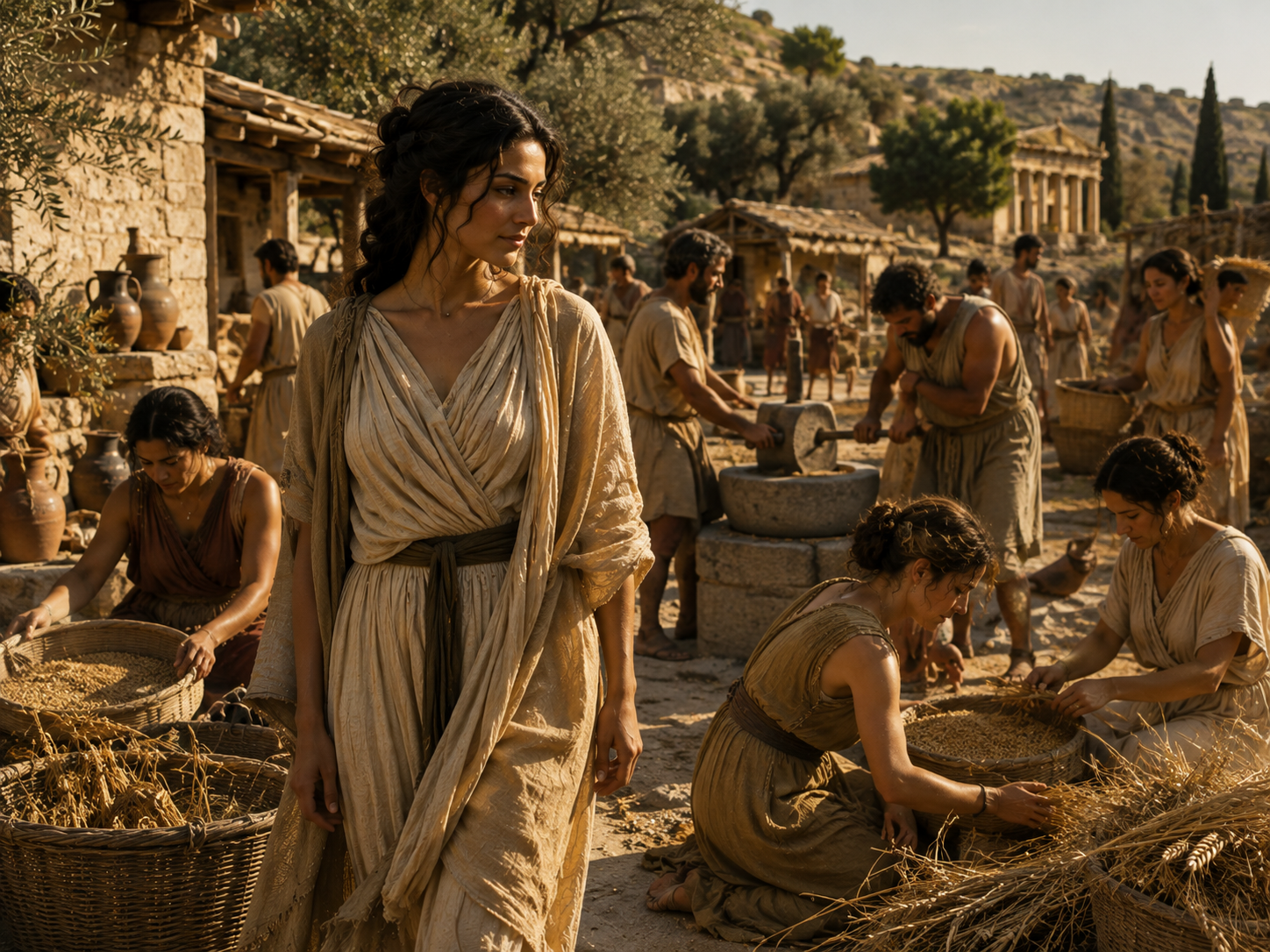
To understand what Astraea contributes to Virgo, we first have to meet her on her own terms. Her name, Astraia, means something close to “starry one” or “star-maiden,” although the mythology surrounding her is not preserved as one singular, consistent biography. In Greek (and later Roman) traditions, Astraea becomes closely associated with Dike, daughter of Zeus and Themis, the personification of justice, and ancient accounts sometimes allow their identities to overlap. Aratus, whose third-century BCE Phaenomena gives us one of the most important Hellenistic accounts of the constellation Virgo, acknowledged competing stories about the Maiden before recounting the tradition in which she is Dike. However, later authors increasingly use Astraea for the celestial maiden who departed humanity and became Virgo. Similarly, for this article, we understand Astraea as the Maiden whose relationship with justice eventually becomes written into the stars.
Yet, “justice” can be a misleading word if we hear it only through our modern associations with laws, courts, punishment, or moral judgment. The Greek dikē had a much wider field of meaning, encompassing what is customary or fitting, the settlement of disputes, and the order through which relationships and communities remain coherent. Behind Dike stands her mother Themis, whose own domain encompasses divine order, custom, and the established patterns by which gods and humans relate to one another. Within this older conception, justice is not simply a verdict delivered after something has gone wrong; it is also a recognition that actions occur within relationships, those relationships carry expectations and boundaries, and departures from them produce consequences. Astraea therefore gives us a way to think about order as a capacity to recognize how things relate and what follows when those relationships change.
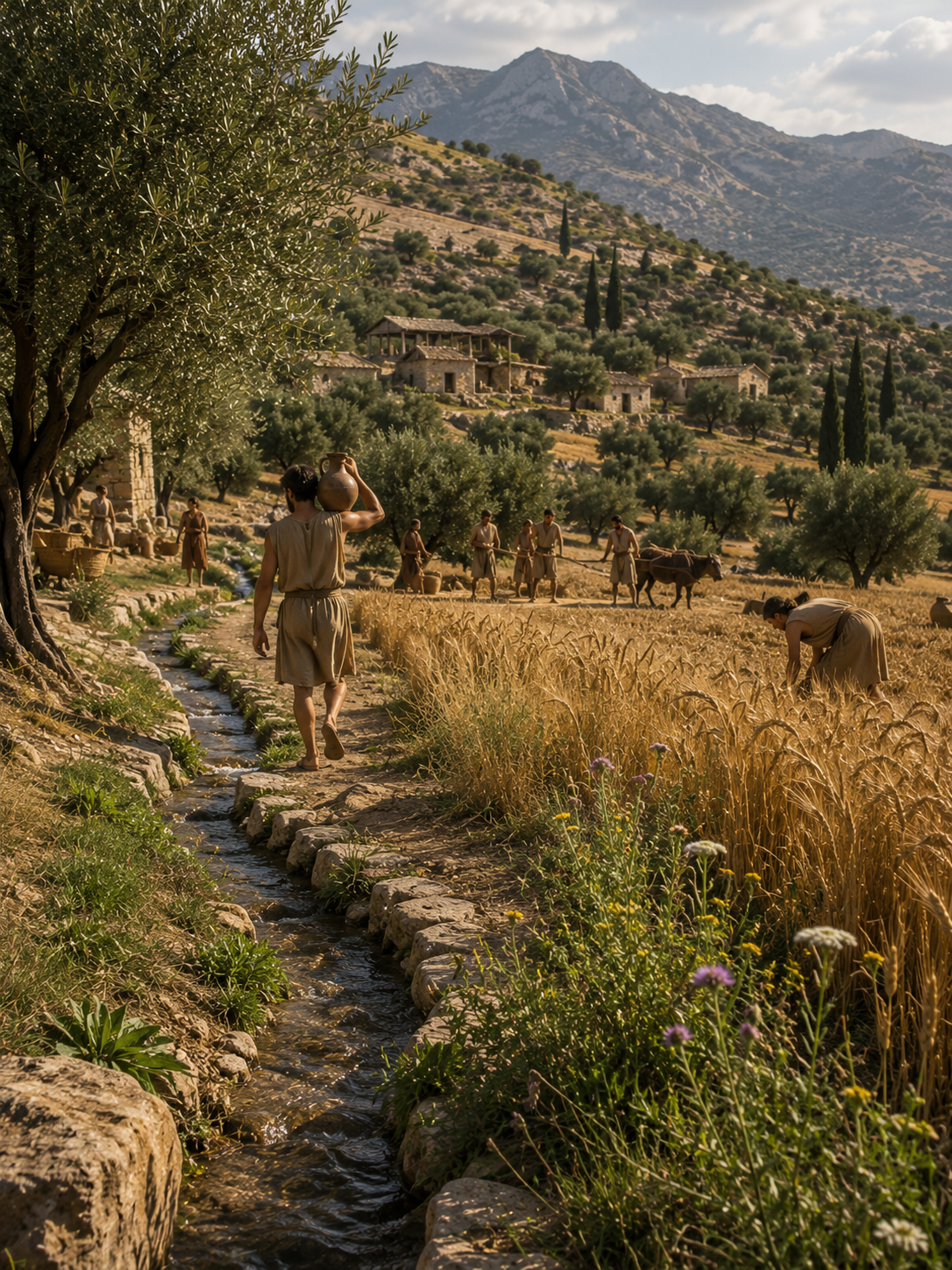
This becomes especially significant because the Maiden of Aratus’s account does not begin in the heavens at all. During the Golden Age, Dike lives openly among human beings, mingling with them and addressing their assemblies. Even as humanity changes during the Silver Age, she still descends from the mountains to speak to them, though she no longer participates as freely as before. Only later, as violence and corruption characterize the Bronze Age, does she finally leave humanity and take her place among the stars.
The movement matters. Astraea is not introduced as a remote celestial authority looking down upon an imperfect world. Her story begins with proximity, participation, and relationship, then traces what happens as the conditions that once allowed that relationship to exist progressively disappear.
Astraea’s justice resembles what we might call natural order: the recognition that life unfolds through relationships among particular conditions and their consequences. Seeds germinate under some conditions and fail under others, communities remain coherent through certain forms of reciprocity and fracture when those relationships cease to function, and what belongs within one environment may become unsustainable when that environment changes. Astraea herself does not create these relationships, nor does she prevent them from changing, but she does recognize and honor them. Before her mythology becomes a story of departure, then, it is a story of presence. To understand why the Maiden eventually leaves humanity behind, we have to look more closely at the world she once participated in freely.
The Lost Golden Age
Astraea’s story begins in the Golden Age, although the Hellenistic account preserved by Aratus gives this familiar myth a particularly earthly texture. Drawing upon the older tradition of Hesiod’s successive races of humanity, Aratus describes the Maiden living openly among the people of the Golden Age. She is seen sitting among them and speaking in their assemblies, where she encouraged laws and justice. During this time, the sea remained unknown to the people, thus foreign goods did not yet arrive by ship, and oxen, ploughs, and Dike herself supplied what they needed. This was not the effortless paradise we might imagine from later descriptions of the Golden Age, nor should we impose upon it a modern ecological ideal. Instead, it represents a world organized around proximity: people gathered together, livelihoods remains tied to the land around them, and exchange had not yet expanded. What distinguishes the age is not the absence of labor or social organization, but a particular relationship among them, in which cultivation provided the material foundation of life.
That proximity begins to change with the Silver Age. Aratus tells us that the Maiden no longer mingled freely with humanity or spoke gently among the crowds. Instead, she withdraws toward the mountains and visits only when she summons the people together, often rebuking them and warning that worse will follow. The movement is subtle but important: Astraea does not disappear the moment humanity changes, she creates distance.
The relationship that characterized the Golden Age had become strained, yet she continued to return, observe, speak, and respond to what she encountered. Hesiod’s broader account of the succeeding races similarly imagines deterioration not as a single catastrophic event but as a progression through changing forms of human behavior, obligation, violence, and relationship. This understanding allows Astraea’s increasing distance to register as a response unfolding over time rather than an abrupt rejection of an imperfect world.
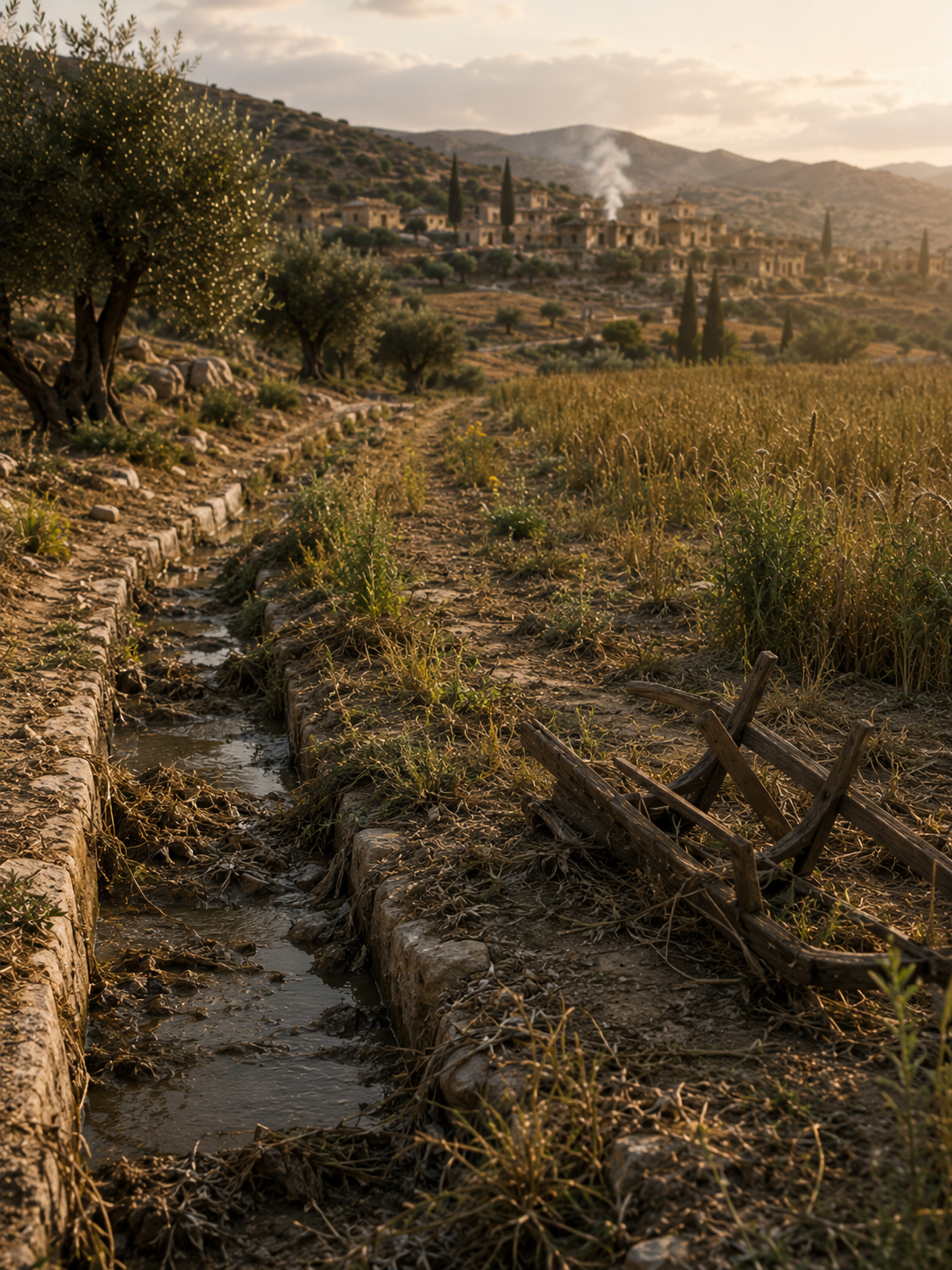
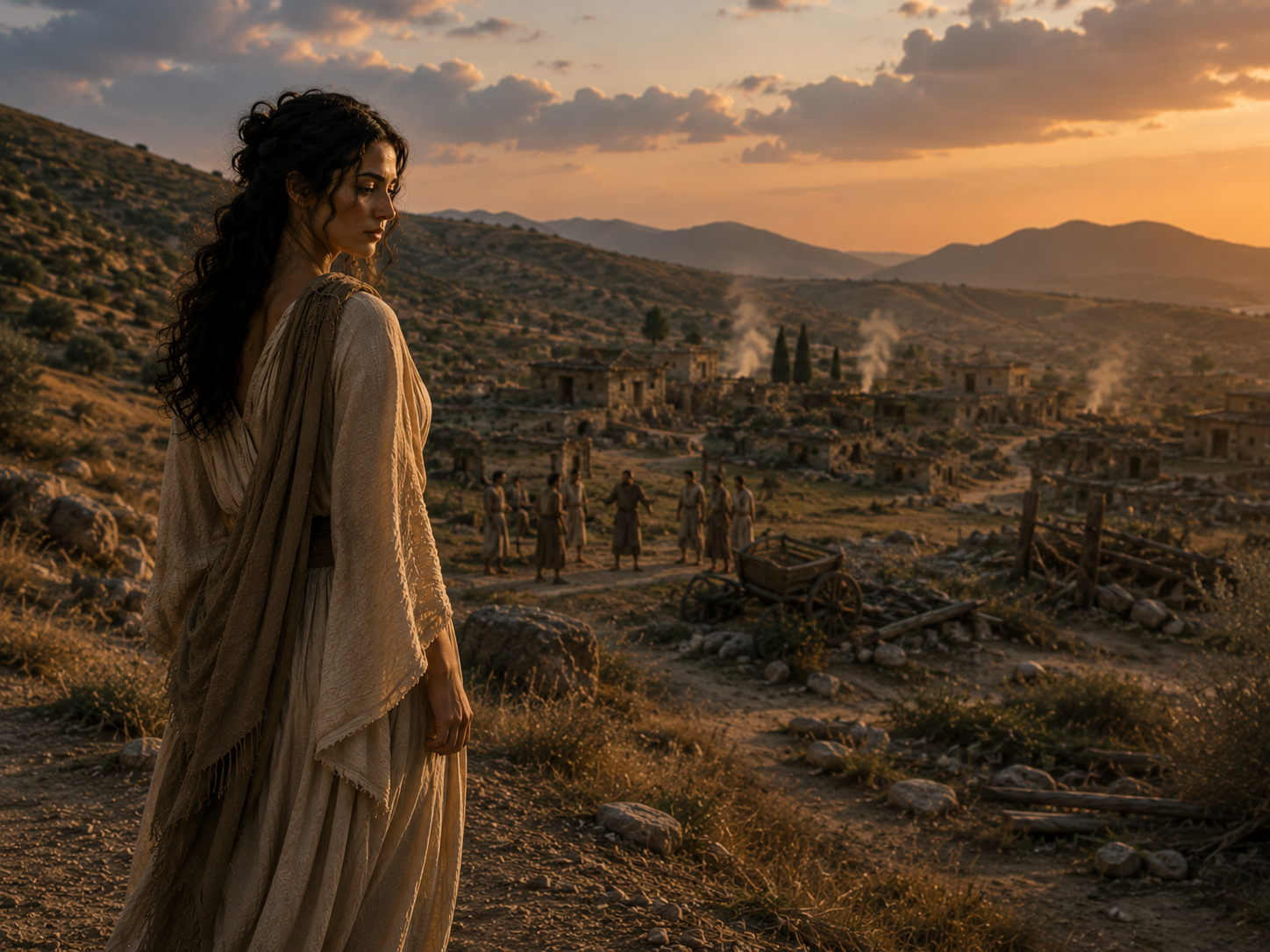
By the Bronze Age, however, the distinction had become impossible to ignore. Aratus describes a generation more destructive than those before it: people who forge the sword of the highwayman, consume the oxen that plough their fields, and turn toward violence that the Maiden cannot participate in. It is at this point that she departs entirely, leaving Earth and taking her place in the heavens. The details are revealing because the rupture is not abstract: the ox that once participated in sustaining agricultural life becomes something consumed; tools and human ingenuity that could support livelihood are redirected toward violence; and the relationships among community, labor, animals, and land no longer resemble those within which Astraea once moved freely. She does not leave because the world has failed to remain flawless, she leaves because what she encounters is no longer the same order in which her presence belongs.
This distinction brings us closer to the discernment Astraea contributes to the Virgo archetype. Before discernment becomes analysis, correction, or judgment, it is simply the capacity to perceive a meaningful difference. The archetypal Maiden does not remain among humanity attempting to perfect the Bronze Age back into the Golden Age, nor does her mythology suggest that integrity requires denying what has changed. She sees the difference and responds to the world as it has become, preserving her own nature rather than forcing the surrounding conditions to conform to it. Her departure consequently transforms her story from one of lost perfection into one of recognition. When Astraea finally leaves the Earth behind, she does not disappear from the myth, she is placed among the stars.
The Art of Cultivation
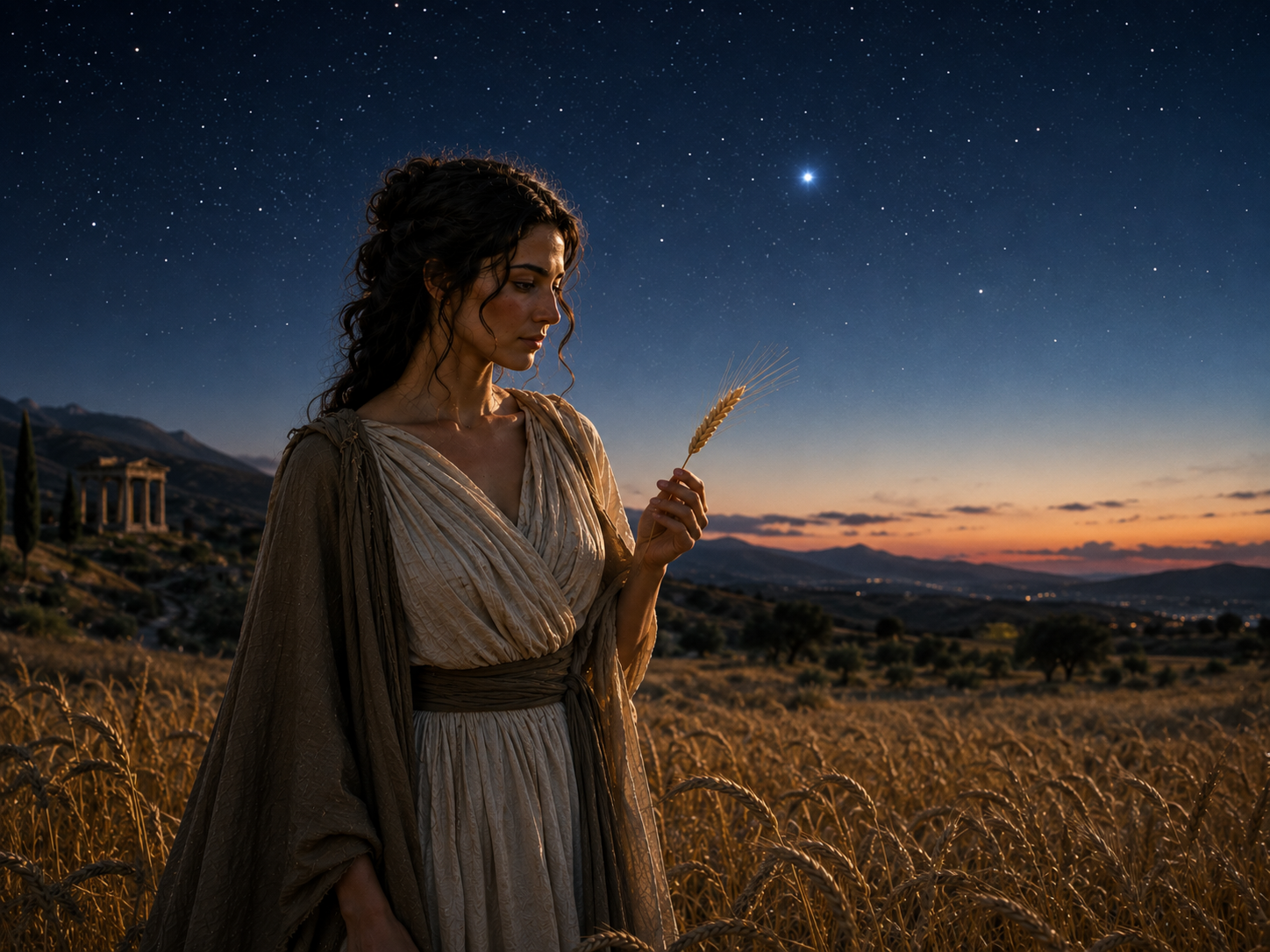
When Astraea leaves humanity, her story moves from the lived landscape into the celestial one. Aratus tells us that Dike departed for the heavens and settled in the region mortals called Parthenos, as the Maiden, where she remained visible among the stars. This identification places the figure we have been following directly within the constellation later known as Virgo. Her placement in the sky preserves what has just been lost on Earth: the Maiden who once moved among humanity becomes a permanent celestial presence, visible even after the conditions of their former relationship have disappeared.
The Maiden also carries something with her, and it complicates any interpretation of Astraea concerned solely with justice or withdrawal. In the constellation, the brilliant star we know as Spica marks the ear of grain held in Virgo’s hand. This grain reaches backward into the story of the Golden Age, which was sustained through oxen, ploughs, and what the cultivated Earth provided. The image therefore connects the celestial Maiden to the material conditions of earthly life: soil must be workable, seed viable, water sufficient, weather tolerable, growth allowed its time, and the grain recognized as ripe before it can become harvest.
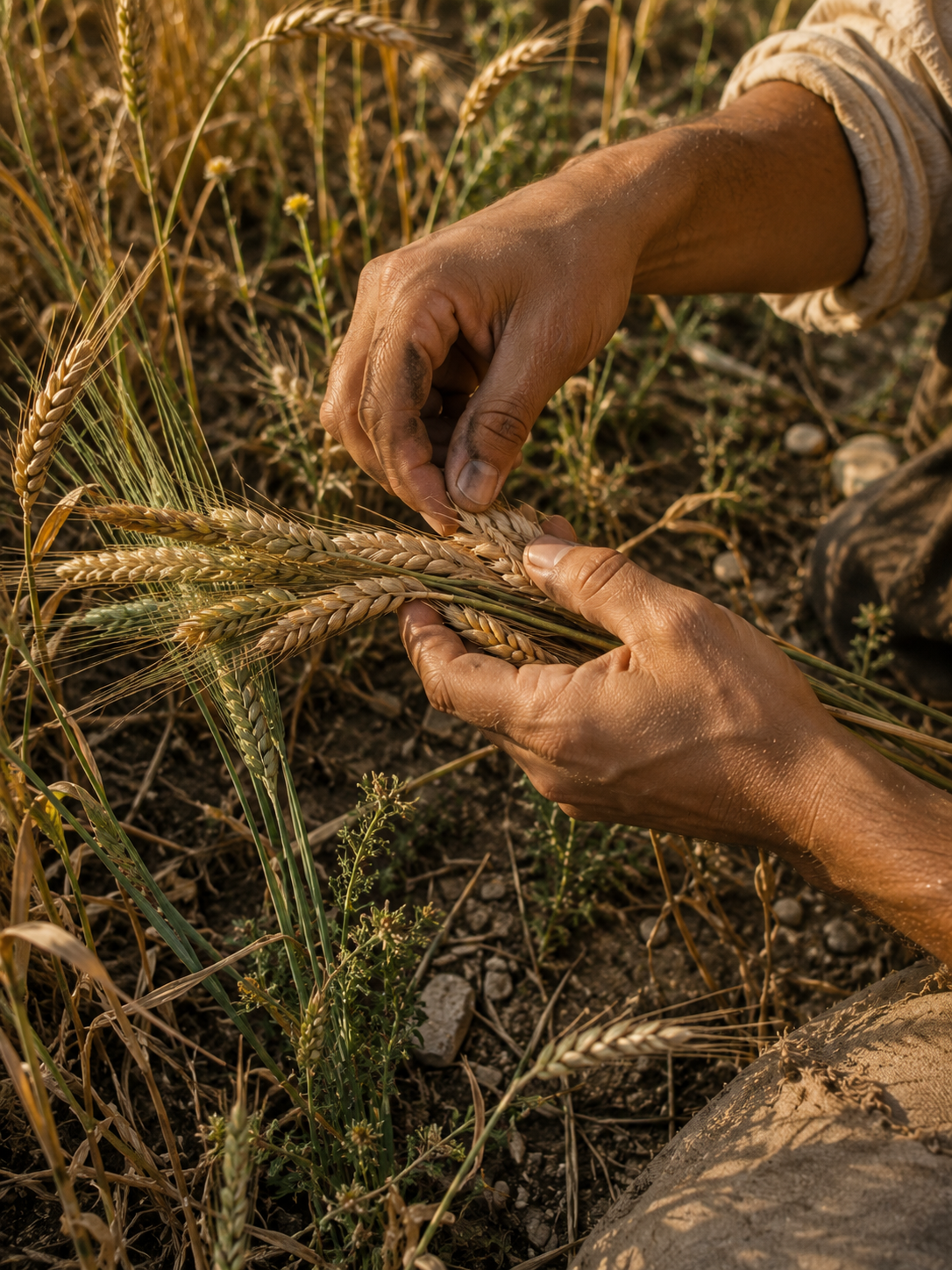
Cultivation makes the importance of relationship in natural order particularly clear because growing something is neither an act of complete control nor one of passive surrender. We cannot command a seed to germinate independently of its conditions, neither does cultivation require us to stand aside and leave every condition untouched. We observe the soil and weather, provide or redirect water, remove competing growth when necessary, recognize disease, protect what is vulnerable, and wait when waiting is what the living process requires.
Each appropriate intervention depends upon perceiving what is actually happening rather than imposing the same response indiscriminately, and every season reminds us that our participation occurs within processes whose entirety remains beyond our control. To cultivate is therefore to enter into relationship with conditions: to act where our actions matter while remaining attentive to the larger patterns within which those actions acquire their meaning.
To keep natural order does not mean preserving the world in a fixed arrangement, any more than cultivation means forcing every stalk of grain to grow identically; it means perceiving relationships accurately enough to understand how, when, and whether our participation belongs within them. Astraea’s discernment encourages us to recognize when conditions have changed, while the grain in her hand reminds us that recognition alone is incomplete. Ultimately, what we notice informs what we tend, and what we tend eventually reveals the consequences of that relationship. Seen through Astraea, Virgo’s celestial Maiden becomes neither an emblem of untouched purity nor a relentless corrector of imperfection, but something more grounded: the figure who can distinguish what the present conditions require and cultivate accordingly. The Maiden who once withdrew when humanity could no longer sustain her presence now carries the harvest that shows us what attentive participation can produce.

Discernment Without Perfection
Having followed Astraea from the human assemblies of the Golden Age to the grain-bearing Maiden in the heavens, we can return to Virgo with a different understanding of the discernment so often attributed to the sign. This archetype does not simply notice details, she recognizes relationships between conditions, actions, and consequences. Thus, her responses change as those relationships change. She can dwell among humanity while the conditions support that relationship, distance herself when they begin to deteriorate, and withdraw when what surrounds her no longer corresponds with what she represents. Through Astraea, discernment becomes contextual: the ability to perceive what is actually present, distinguish it from what was present before, and respond to reality rather than to an expectation.
This offers a useful alternative to Virgo’s familiar association with perfectionism, because nothing in Astraea’s story requires the natural world itself to be perfect. Nature is full of variation and irregularity, generation and destruction, abundance and scarcity, growth and decomposition. Even a cultivated field contains competing plants, uneven ripening, exhausted soil, changing weather, disease, and eventual death.
What Astraea preserves is not freedom from these conditions, but integrity within them, or the coherence that allows relationships to remain viable even as their circumstances change. Her departure from humanity occurs when that integrity can no longer be maintained in the same way, suggesting that the Virgoan sensitivity to discrepancy need not uphold an ideal against which reality is judged. Instead, it can represent attention given to whether the relationships sustaining something still function.
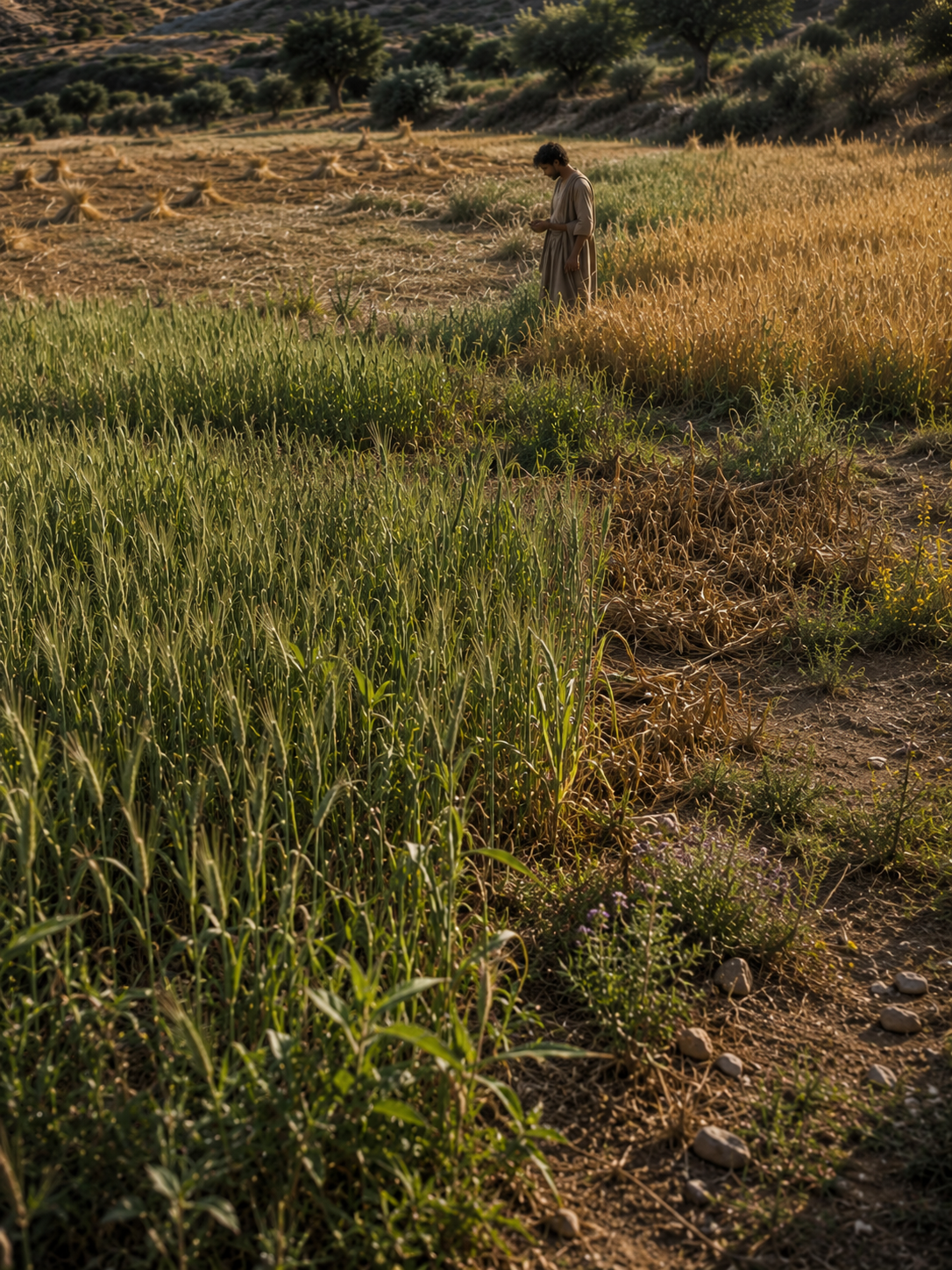
The grain carried by the Maiden takes that recognition one step further by turning discernment into cultivation. Once we perceive conditions clearly, difference becomes useful information: this seed is viable while another is damaged, this growth requires intervention while another should remain untouched, this portion of the field is ready for harvest while another still needs time, etc.. Cultivation depends upon these distinctions, yet none of them require the cultivator to make the living system uniform. They allow us instead to respond selectively, in order to preserve, remove, adjust, protect, wait, harvest, or release according to what each condition reveals. Virgo’s refinement is about developing enough attention to tend things according to their nature.
Natural order, then, is neither something Astraea invents nor something Virgo imposes upon an unruly world; it is something we encounter through continued relationship with a world that never stops changing. What sustained growth yesterday may be insufficient tomorrow, what once required intervention may later require patience, and what we have carefully tended will eventually reach the point when keeping it means allowing it to become something else. Therefore, conscious alignment cannot be a fixed achievement. It requires us to keep noticing, distinguishing, and responding as circumstances unfold.
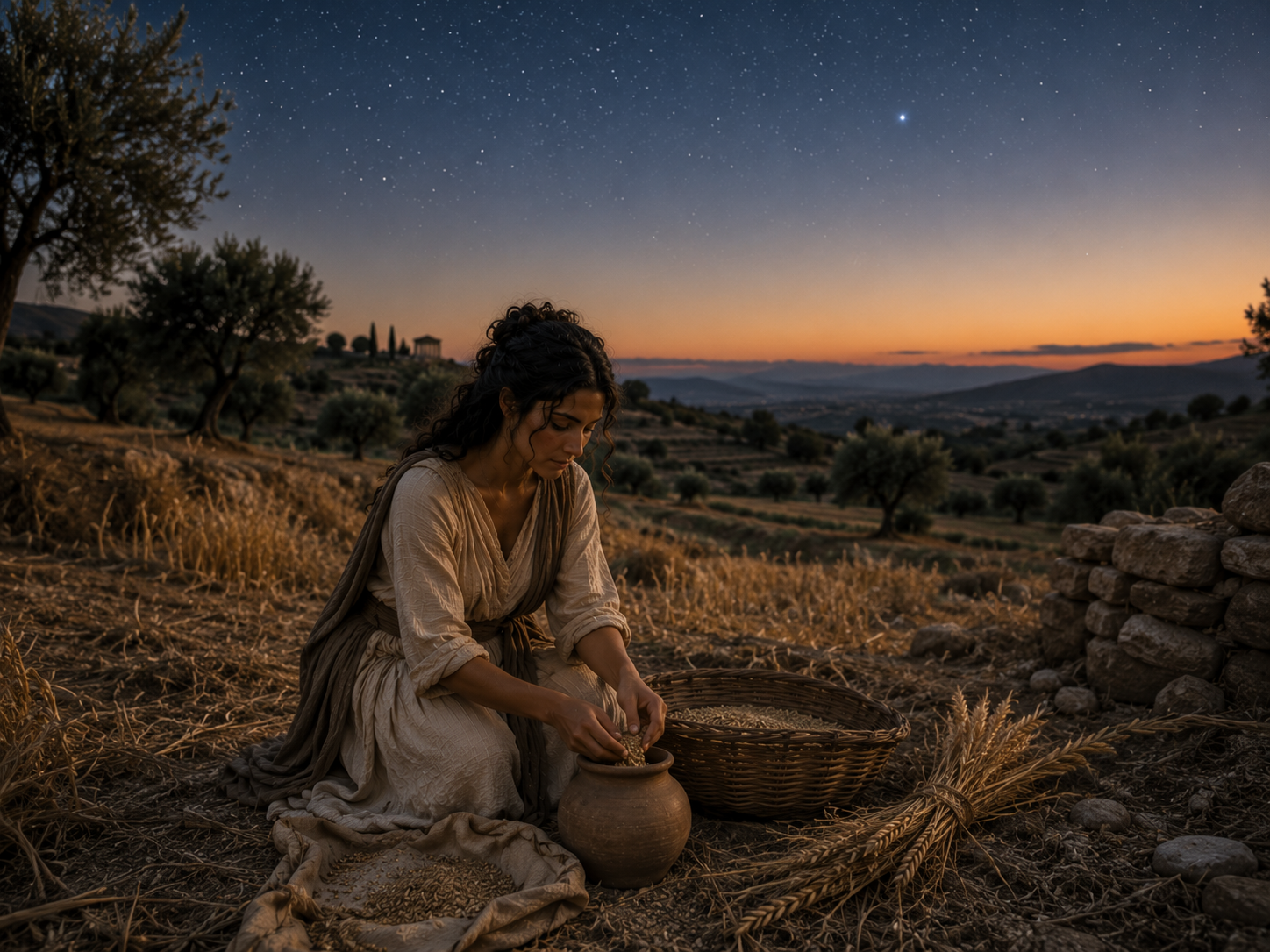
The Order We Cultivate
Astraea’s journey carries her from the human assemblies of the Golden Age, into the mountains as the world begins to change, and finally beyond the Earth she once inhabited to become the Maiden among the stars. Yet the figure who remains there does not carry a sword, a verdict, or an image of punishment; she carries an ear of grain. That grain belongs to a relationship unfolding across time: between seed and soil, weather and season, and human attention to living processes. She teaches that conditions, actions, and consequences cannot be separated from one another, and that what eventually ripens bears some trace of the relationships through which it was allowed to grow.
Nature contains both the flourishing field and the exhausted one, germination and decomposition, abundance and scarcity, cooperation and competition, growth that should be tended and endings that should be allowed to complete themselves. Thus, keeping natural order cannot mean holding life indefinitely within whichever arrangement we prefer; change itself belongs to the order. Available to us within that is our own attention: the capacity to notice these movements as they occur, to recognize when a relationship has changed, and to remain conscious of where and how our participation belongs within what is becoming.

Authentic Routines
Take regular, inspired, & adaptable steps towards your long-term goals!
May we all learn to notice before we judge, to distinguish before correcting, and to understand the conditions surrounding something before attempting to change it. May we cultivate without mistaking that act of stewardship for control, recognizing when circumstances have genuinely changed and remaining attentive to what’s revealed to us. May we know when to tend and when to wait, when to preserve and when to release, when something still needs time and when it has finally become ripe. Above us, Astraea and Virgo remain the celestial Maiden carrying the grain, as the keeper of natural order.
Thank you for joining us here on Onescence! If you enjoyed this article, your can help support our free periodical by becoming an Onesce Insider or purchasing one of our products through Onesce Press. Given your interest in astrology and personal sovereignty, perhaps you would benefit from:
Moon Cycle Journey

JOURNAL FEATURES:
- Learn about the rhythms of the lunar cycle and how to apply them to your own journey.
- Explore your cycle goals, developing and working with your own authentic intentions.
- Discover the power of personal feedback for enhancing and sustaining progress.
- Utilize daily/nightly journal prompts that are designed to bring out your best.
- Experiment with simple ritual ideas and when to employ them throughout the cycle.
- And so much more…
You can also get your copy on Amazon and begin your journey with the next moon cycle!