

This Beltane, I am approaching my editorial a bit differently, by sharing one of the considerations that I’ve been preoccupied with lately. I call it: The Avocado Theory.
Commitment, responsibility, and discipline were not always concepts that felt comfortable to me. For much of my life, they carried weight. They implied pressure, expectation, and a kind of force that I believed I had to impose upon myself in order to become “successful” or “worthy.”
Over time, however, things have shifted. These once reluctant ideals no longer register as burdens. They feel more like gravity: steady, reliable, and inherently present. What once felt restrictive now feels directional and what once felt imposed now feels available. I did not set out to develop resilience or determination, yet through my own process of healing and realignment, I have arrived at a place where these qualities feel natural, expansive, and even generative.
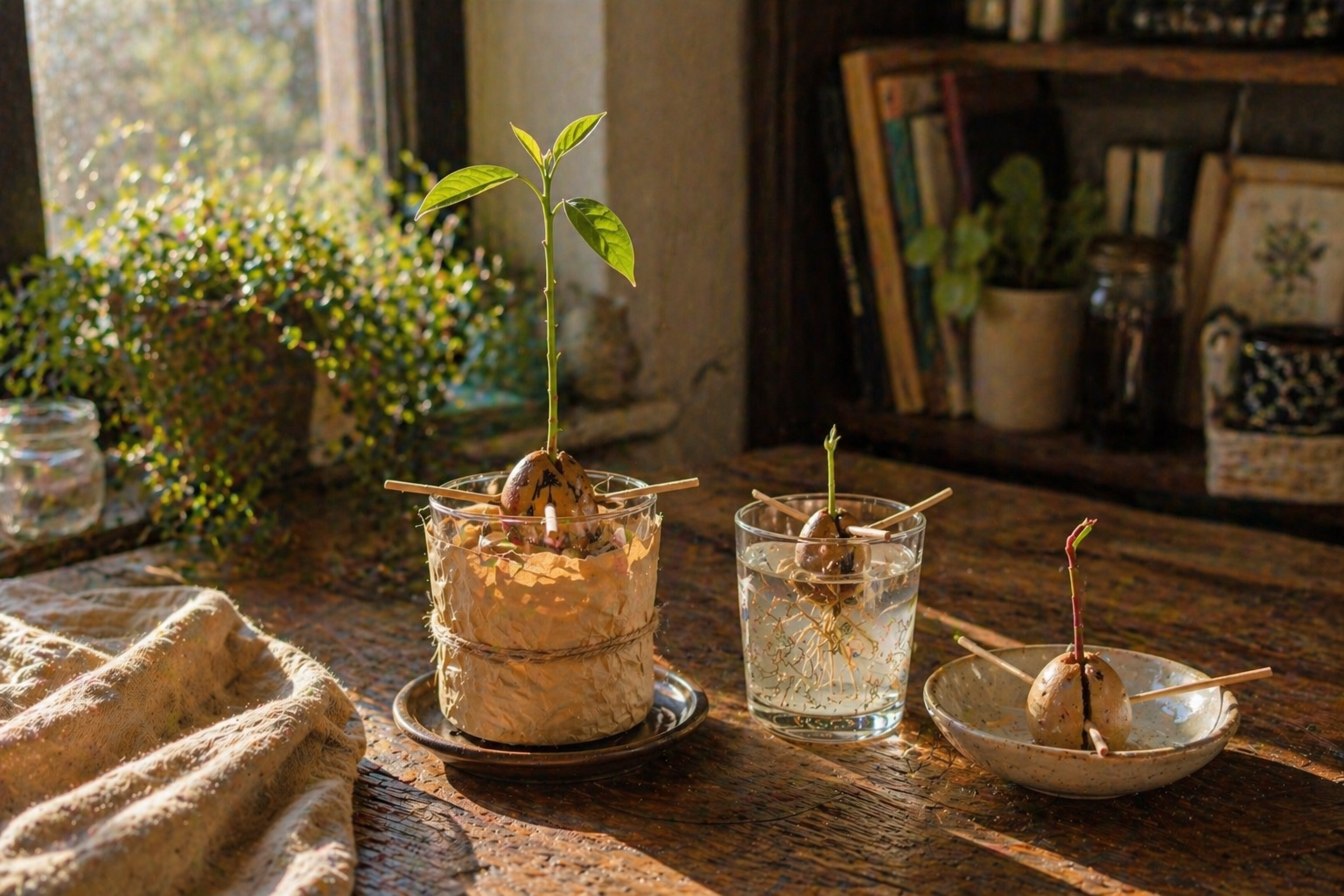
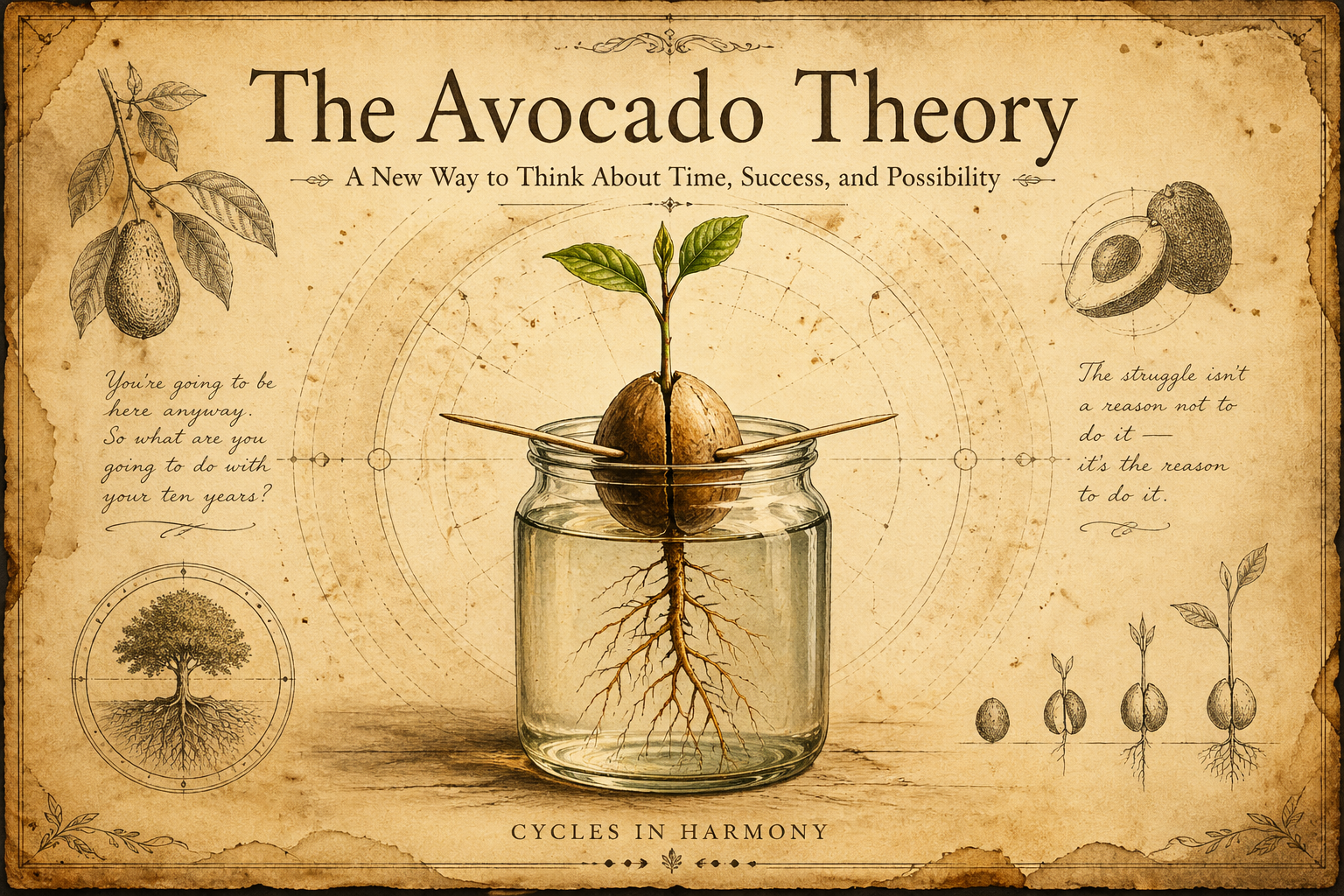
This shift did not occur suddenly, unfolding instead over decades of lived decisions, many of which appeared insignificant or incorrect at the time… And, somewhere along that process, I began sprouting avocado seeds. The act itself was simple, to the point of being unremarkable. However, a passing comment a friend made about the length of time it would take for those seeds to mature revealed something more substantial… They made this 10-year maturation period seem as though it were a reason not to do it at all.
Looking back to see these different perspectives, both mine and my friend’s, has helped bring into focus a pattern I had already started living then, which I had been painstakingly developing for years. Despite not understanding or appreciating it at the time, I have recently come to refer to this framework as The Avocado Theory. It’s a different way of understanding time, success, and possibility; challenging the assumptions most of us have been taught to accept blindly. Ultimately, it’s given me a convenient metaphor for the way I have reshaped my relationship to effort and fulfillment, helping me conceptualize a fundamentally different way of moving through life.
An Avocado Seed: Proof of Possibility
Today, my growing avocado plants exist as a quiet and humble kind of evidence. They are not particularly dramatic, nor are they especially refined in their appearance, yet they offer something far more valuable: continuity. Each new leaf, each slight extension of stem or root, reflects a process that has been sustained over time without urgency or spectacle. When I notice them, I experience a small but distinct sense of satisfaction. It is not fleeting in the sense of being insignificant, but rather, an ongoing return to appreciation.
This response is meaningful to me because it marks a departure from how I once related to my own life. My orientation toward the world was, for a long time, defined by pessimism. Anxiety, depression, and periods of deep internal conflict shaped the way I interpreted both my circumstances and my potential within them throughout childhood and young adulthood. Under those conditions, possibility was not something I trusted. Even when opportunities were present, my attention remained fixed on limitation, risk, or eventual disappointment. The result was not only a reluctance to act, but a forfeiture of the value within the present moment. Experience became something to endure rather than something to engage or enjoy.
The process of changing that orientation began as necessity rather than inspiration. Early on, the effort was all directed toward maintaining stability in turbulent waters. Over time, however, that effort evolved into a more deliberate practices for personal growth.
I eventually learned to observe my own thought patterns, to question the assumptions underlying them, and to reframe those assumptions when they proved to be limiting or inaccurate. The effect of that work has been a shift in expectation. Where I had once anticipated difficulty, I learned to allow for possibility instead.
Though the avocado plants did not create that shift, they do reflect it. Their presence in my space is a direct result of a decision to act from a place of possibility rather than hesitation. That decision did not require certainty, nor did it depend on a guarantee of outcome. It required only a willingness to engage with a process even when its value was not immediately measurable or at all guaranteed. In that sense, the plants remind me that optimism, when practiced consistently, produces its own form of satisfaction.
There is nothing extraordinary about planting a seed. What gives the act significance is the context in which it occurs. In this case, it represents a shift from avoidance to participation, from passive endurance to active engagement. The growth that follows a choice to commit to a process is not remarkable because it is rare, but because it arises from the energy of potential rather than lack.

The Question: What Will You Do?
The moment that clarified this spit in perspective for me did not arrive as some grand realization. It was just a simple, casual exchange while I was in the early stages of growing my avocado seeds. Someone in my life merely pointed out that it would take ten years for those seeds to grow into fruit-bearing trees, and they followed that by explaining that I would need both male and female plants for anything to come of it. The information itself was not wrong, and in another phase of my life, I would have received it as a reason to stop… After all, that way of thinking had shaped many of my decisions in the past, often presenting itself as practical, responsible, and even intelligent.
What I noticed in that moment, however, was not the content of what was being said, but the energy behind it. I recognized that orientation immediately, because I had lived within it for so long. It was the same pattern that measures effort against uncertainty and searches for reasons to justify inaction. It was rooted in fear, even when it presented itself as logic, and it had once kept me from beginning many things myself. At the same time, I became aware of something else that felt equally important: I was no longer responding from that place. There was no internal debate, no hesitation, and no need to defend what I was doing.
Instead, I found myself settling into a much simpler understanding of the situation. The ten years being referenced were not a new condition that I had to account for, but an existing reality that would unfold regardless of my decision. Time was not being introduced into my life through this choice, nor could it be avoided by choosing differently. That recognition shifted the entire framework through which the decision was being evaluated. I was no longer asking whether something was worth ten years, because the ten years were already present and moving forward.
From that perspective, the question changed in a way that felt both grounding and liberating. I was not deciding whether to commit to a long-term outcome, but whether I was willing to engage with something meaningful during the time that was already mine. The need to justify the action through certainty or measurable return had fallen away, because it no longer held relevance. What remained was a much more honest consideration of how I wanted to live and what I was willing to participate in. This is the point at which The Avocado Theory starts to become lived.
When I look back on that moment now, I understand that the statement “this will take ten years” is not inherently limiting. It becomes limiting when it is used as a reason to avoid beginning, and it becomes expansive when it is recognized as a neutral condition of existence. The difference does not exist within time itself, but within the way we interpret it. Once that becomes clear, the question we are left with is far more revealing than any calculation of effort or reward: “What are we willing to do with our time, as it is already unfolding?”

The Theory: Energy → Action
By the time I sprouted those seeds, the action itself was not the most important part of what I was doing. The decision had already been made long before my hands ever touched water, glass, or seed. THE change was the energy from which I was approaching my life. That shift is subtle, but foundational. It determines not only what we choose to do, but what we perceive as available to us in the first place. When I look back on that moment now, I do not see it as an act of planting; I see it as an act of alignment.
In the past, my decisions were often filtered through fear, even when that fear was disguised as logic… Just like my well-intentioned friend. I would evaluate opportunities based on potential risk, imagined outcomes, or whether I believed I could sustain the effort required. That process felt responsible, but it consistently led me away from experiences that might have expanded me. I was not responding to life as it was. I was responding to a projection of what I believed might go wrong. Over time, that orientation created self-fulfilling limitations. I did not see possibility, so I did not act, and because I did not act, nothing new could emerge.
What I began to understand, slowly and through lived experience, is that action does not originate from circumstance. It originates from state. The energy I embody before I make a decision determines how I interpret that decision. It determines whether I see something as an opportunity, a burden, a risk, or a waste of time.
When I approached those avocado seeds, I did not need to convince myself that they would succeed. I was already in a state that allowed for the possibility of growth, and that was enough. The action then followed naturally from that orientation.

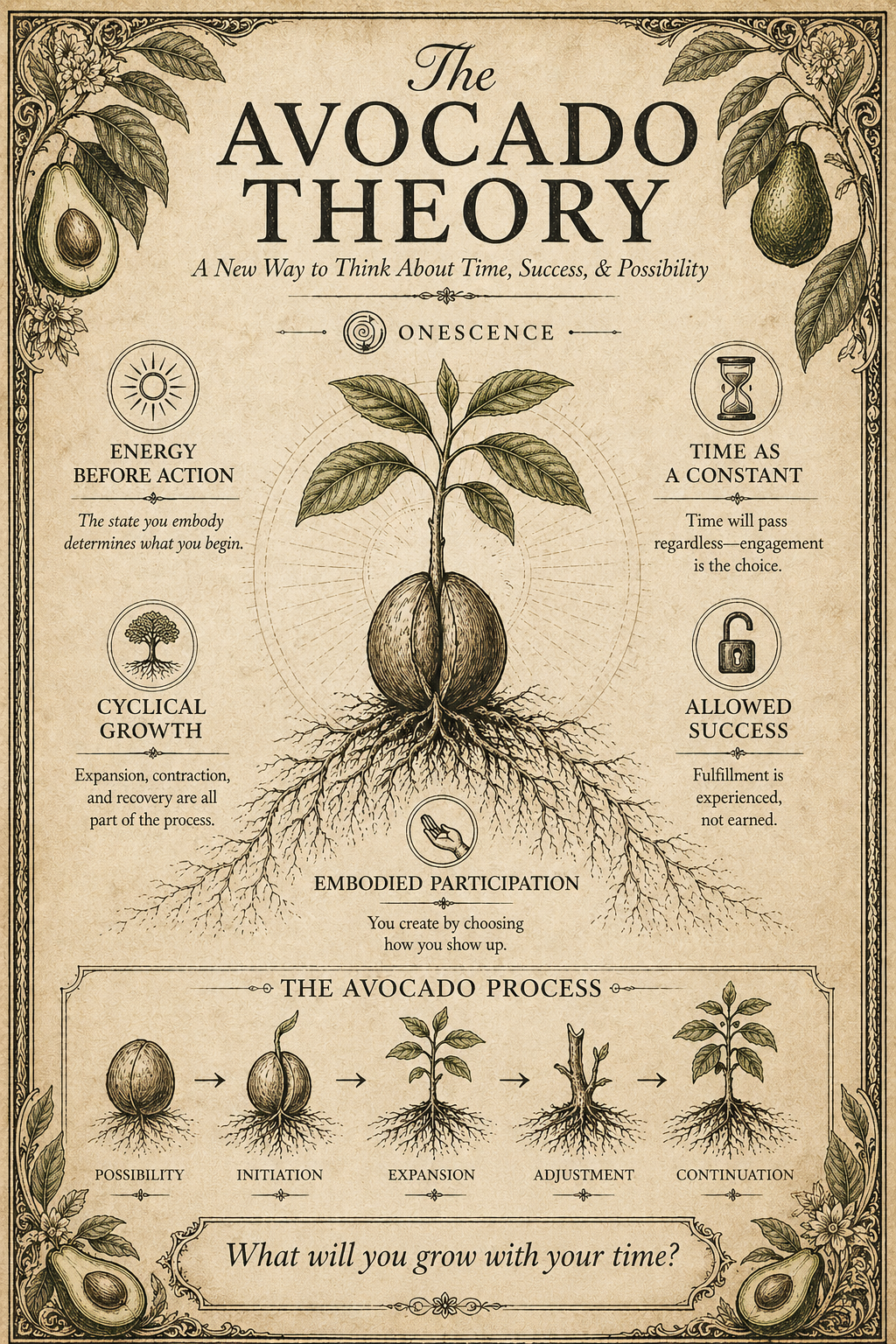
This is the core of The Avocado Theory: the quality of our experience is shaped long before any “results” appear. When we operate from a state of possibility, curiosity, and openness, we do not require guarantees in order to begin. We are no longer withholding our engagement until the future becomes certain. We start participating more in the present because the present itself feels worth engaging with. That distinction changes the entire nature of commitment; it no longer feels like something we must force. It becomes something we choose, repeatedly, because it aligns with how we want to experience life.
This is also where many of us become caught in patterns that feel difficult to break. We attempt to change our actions without addressing the state that produces them. We try to force consistency, discipline, or motivation while still operating from a place of doubt or fear. That approach will always feel strained, because it is working against the underlying orientation rather than with it. Yet, when the energy shifts, the actions begin to reorganize themselves… What once required effort begins to feel natural, not because the work has changed, but because the relationship to it has.

Growth Is Cyclical, Not Linear
It’s “nice” to assume that once something is started, the rest is simply a matter of time and consistency. However, that assumption reflects a linear understanding of growth, where effort leads predictably to outcome, and progress moves in a steady, upward direction. Life though, rarely follows that pattern. What I have observed instead is something far more dynamic, and far more reflective of nature itself.
There have been periods where my avocado plants appeared to thrive without much intervention, extending upward, producing leaves, and responding visibly to their environment… But, there have also been moments where everything seemed to stall, and even regress. At one point, I had to cut them back significantly after encountering issues with root health, and there was a genuine possibility that I might lose them entirely. In the past, I would have interpreted that kind of disruption as failure or as “evidence” that I had done something wrong from the start, that it really wasn’t “worth it.” Also in the progressed energy of optimism though, I could understand it differently. What I was witnessing was not a breakdown of the process, but an expression of it.
Nature does not operate in straight lines. Growth includes expansion, contraction, adaptation, and recovery, all of which serve a purpose within a larger cycle. When I look at these plants now, I do not see a single trajectory toward maturity. I see a series of responses to changing conditions, each one contributing to their overall resilience. The pruning, the setbacks, and the periods of uncertainty are not interruptions to growth; they are integral to it. Without those phases, the system does not strengthen, merely extending until it can no longer sustain itself.
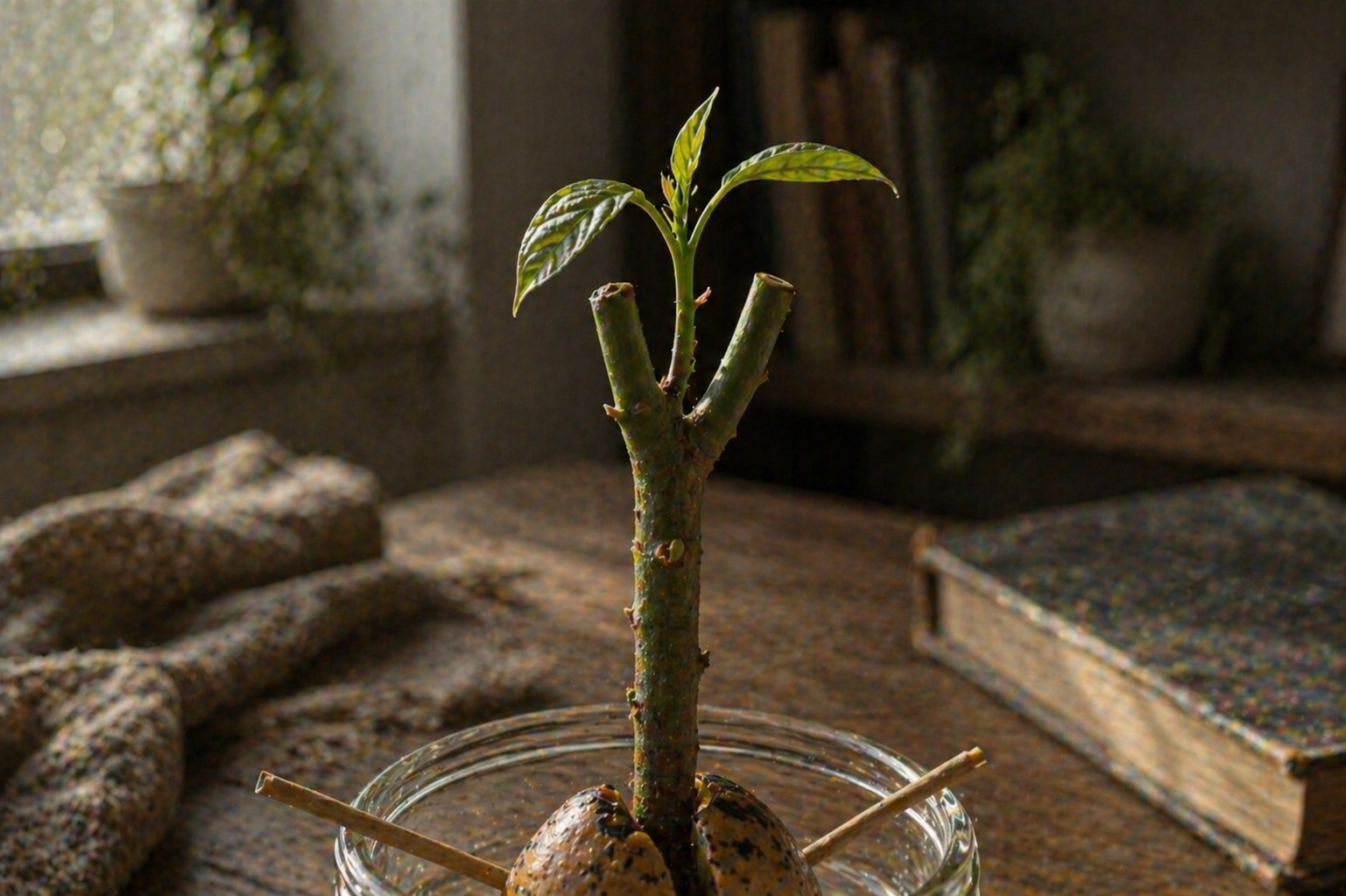
Perspective alters the way we relate to our experiences. After doing the work, difficult periods no longer carry the same implication of being off track or moving in the wrong direction anymore. Instead, they simply signal a different phase within a cycle is unfolding.
That does not mean that every outcome is desirable, or that a challenge should be accepted unquestioningly… But for me, it means that I no longer require my life to appear consistently progressive in order to trust that it is moving in meaningful ways. The expectation of constant achievement has been replaced by an appreciation of life’s natural, rhythmic cycles, where each phase informs the next.
The Avocado Process, then, is not about maintaining perfect conditions or even avoiding disruption. It is about remaining engaged with what is actually happening, and responding to it as it evolves. When I encounter a challenge, I address it within the context in which it appears, rather than interpreting it as a failure of the original decision. When growth accelerates, I allow it to unfold without attempting to control its pace. Over time, this approach creates a more sustainable relationship with both effort and outcome, mirroring the natural systems I have chosen to learn from.
What this process ultimately reveals is that growth is not something we achieve once and then maintain. It is something we participate in continuously, across shifting conditions and changing forms. The value is not found in reaching a final state, but in remaining present within the cycles of life as they are happening for us. When I embody growth in this way, I am no longer trying to force my life into a linear progression; I am allowing it to move as it is designed to move, and I am choosing to move with it.

Success: Allowed, Not Earned?
By the time I had stayed with this process long enough to witness its cycles—growth, disruption, pruning, and return—I began to notice that something else had shifted alongside it. My understanding of success was no longer tied to an arbitrary outcome that was off, waiting somewhere in the mysterious future… It was no longer something I distanced myself from by believing that I had to “earn it” first through effort, endurance, or proof. Instead, it began to feel like something present, independent of happening. For me, it emerged gradually through lived moments of satisfaction, arising quietly, organically, and without permission.
For most of my life, success had been defined by external markers or delayed milestones. It was positioned as a destination that required sustained effort before it could be accessed, which meant that the present moment often felt insufficient by comparison. Even when I was actively working toward something meaningful, there was a persistent sense that I was not yet where I needed to be. However, I now see how that orientation itself created distance between my actions and my experience of fulfillment. It suggested that no matter what I was doing, it could only matter later. In practice, that belief made it difficult to feel satisfied at all.
It’s strange, because what has changed as a consequence is not the presence of effort in my life, but my relationship to it. I still commit, I still show up, and I still engage with processes that require time and attention… Honestly, even more so. The difference is: I no longer treat those efforts as transactions through which I might eventually earn the right to feel fulfilled.
The fulfillment is available within the act itself. When I tend to these plants, I am not waiting for them to produce something in order for the experience to have value. The act of tending is already sufficient. It provides a sense of alignment that is not dependent on future validation—if I allow it to.
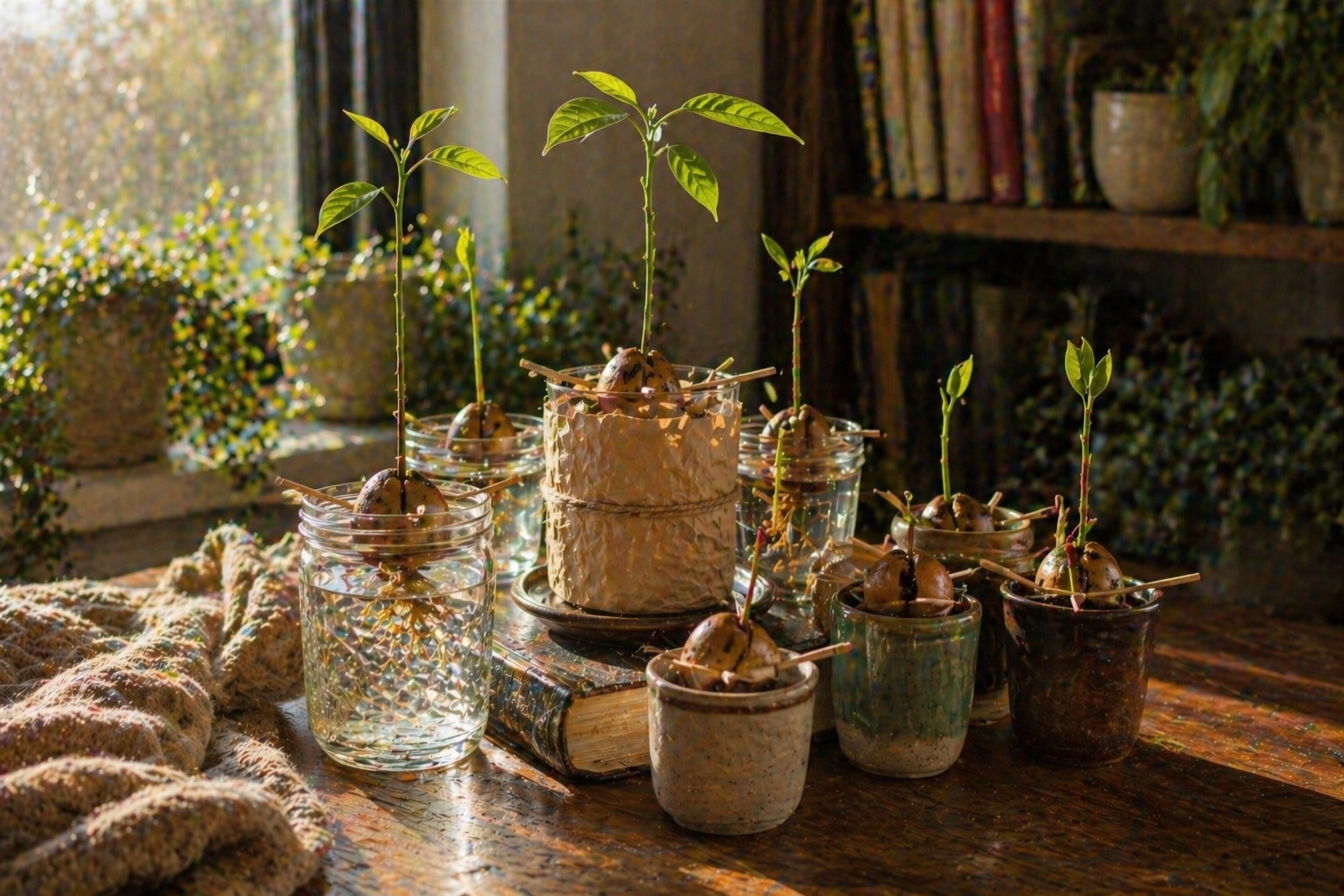
This is where the Avocado Theory really extends beyond decision-making, into behavior and lived experience. When we approach our lives from a place of possibility, we allow ourselves to recognize the quality of our experiences. That does not mean that I no longer have goals, or that I have abandoned the desire to create or achieve; it means that those pursuits are no longer prerequisites for the fulfillment they inspire in me. They are more expressions I get to have of it.
When success is understood as something experienced rather than earned, it becomes immediately accessible to all of us as a quality of engagement. From that perspective of optimism, the question is no longer whether we will succeed at some point in the future., becoming: “Are we willing to truly experience life, embracing the fulfillment that is always present?”

If We’re Going to Be Here Anyway…
When I think back to that original moment—the seed in my hand, the comment about ten years, the quiet decision to move forward anyway—I no longer see it as small, casual exchange. It was never about growing an avocado tree… It was about choosing how I relate to time, to effort, and to my own life. It’s why, even though The Avocado Theory isn’t something I ever set out to define, it ultimately revealed itself through experience, repetition, and my willingness to reclaim it all.
Time is not the barrier we have been taught to believe it is. It does not need to be justified, optimized, or resisted in order for our lives to hold value. It will move forward regardless of what we choose to do with it. The same is true of uncertainty, of challenge, and of change. None of these conditions are optional. What is optional is our participation. We can spend that time hesitating, calculating, or deferring, or we can engage with something that feels meaningful, even if the outcome is unknown.

Moon Cycle Journey
Enhance your life with lunar wisdom, attuning to the rhythms of nature.
The Avocado Theory does not promise results, and it does not attempt to control them. In fact, it asks a different set of questions entirely: “Are willing to show up in a way that allows life to move through us, rather than holding it at a distance until we feel certain?” and “Are willing to let success exist within the act of participation itself, rather than reserving it for some future moment?” When I approach my life from that place of possibility, I find myself in the flow, because I was already in that state.
May we all allow ourselves to begin without certainty, to continue without constant validation, and to recognize the value of what we are building even while it is still unfolding. May we choose to participate in and enjoy our lives as they are, rather than waiting for them to become something else… And may we remember, again and again, as often as we must: if we are going to be here anyway, we might as well spend that time growing something optimistic.
Take care and blessed be,


Thank you for joining us here on Onescence! If you enjoyed this article, you can support this free, online periodical by becoming an Insider member or purchasing one of our products through Onesce Press. Given your interest in transformation and personal sovereignty, perhaps you would benefit from:
Plant Medicine Companion
WORKBOOK FEATURES:
- Worksheets to help you prepare for a plant medicine experience, whether a single ceremony or full retreat.
- Pre- and post-journal prompts for both insight into your intentions and to help integrate your experiences afterwards.
- Apply guidance from a variety of worksheets to stay on track throughout your dieta, journey, and integration.
- Enjoy the ease and clarity that comes with knowing you’ve covered all the details—letting yourself focus on what matters most.
- And so much more…
For support on your journey of transformation, from planning through to integration—you can also get your copy on Amazon!